Miami-Dade recorded 24 residential transactions above $30 million during the first half of 2026, more than New York City and the San Francisco Bay Area. The milestone confirms Miami’s growing influence at the top of the global property market, but it also reveals a highly concentrated market powered by cash, scarce waterfront land and mobile private wealth.
Miami | July 25, 2026
Miami has moved ahead of New York and the Bay Area in one of the most exclusive segments of American real estate.
In the first six months of 2026, 24 Miami-Dade condominiums and single-family homes closed for more than $30 million, according to data from real estate analytics firm Analytics Miami reported by Bloomberg. That was nearly twice the number sold during the same period a year earlier and placed the county on pace to exceed the record 33 transactions completed in all of 2025.
New York City recorded 17 sales above the same threshold, while the Bay Area recorded nine. The comparison gives Miami a clear lead by transaction count in the rarefied $30 million-plus category.
It is an arresting result, but it requires precision. Miami has not overtaken New York in the size of its entire housing market, and “hottest” is not a standardized economic designation. The defensible conclusion is narrower and still significant: Miami-Dade led the three major markets in closed residential transactions above $30 million during the first half of 2026.
The Numbers Behind Miami’s Ultra-Luxury Lead
| Market | $30M-plus sales, H1 2026 | Interpretation |
|---|---|---|
| Miami-Dade County | 24 | Nearly double its year-earlier pace and tracking above the 2025 annual record. |
| New York City | 17 | Still one of the world’s deepest luxury markets, but behind Miami in this specific price tier. |
| San Francisco Bay Area | 9 | Substantial technology wealth, with fewer completed transactions above $30 million. |
The $30 million threshold matters because it isolates a market governed by different forces than conventional housing. Mortgage-rate changes have limited influence on buyers capable of closing with cash. Inventory is measured in exceptional estates and trophy condominiums, not thousands of interchangeable units. Privacy, water access, lot size, security and architectural quality can matter more than traditional price-per-square-foot comparisons.
The broader luxury market is also advancing. MIAMI REALTORS reported that Miami-Dade completed 483 residential sales of at least $1 million in June, a 29.1% increase from a year earlier. Total countywide home sales increased 14.3% to 2,107, producing Miami’s strongest June since 2023.
That wider improvement makes the $30 million surge more meaningful. It is not an isolated cluster of trophy trades occurring against a completely dormant luxury market. Activity has strengthened across the million-dollar segment, even though performance varies sharply by property type, location and building quality.
Why Miami Is Winning Ultra-Luxury Demand
There is no single explanation for Miami’s rise. The market sits at the intersection of domestic wealth migration, international demand, constrained waterfront supply and a maturing private-capital ecosystem.
Tax and residency strategy
Florida has no individual state income tax. For high earners and business owners who establish a genuine Florida domicile, that distinction can materially affect long-term wealth planning. Tax considerations are influential, although never the only reason for a move.
Scarce waterfront property
Miami cannot manufacture more islands, bayfront lots or direct-ocean frontage. The most desirable properties combine privacy, water access and proximity to Miami Beach, Brickell and the region’s business infrastructure.
Global accessibility
Miami functions as a gateway between North America, Latin America, Europe and the Caribbean. Its international airport, private aviation facilities and multilingual professional-services network support globally mobile households.
A deeper wealth ecosystem
Private banks, family offices, investment firms, luxury hospitality, art institutions and high-end service providers have expanded alongside the resident wealth base. Miami increasingly operates as a year-round capital center rather than a seasonal resort market.
Corporate and financial migration reinforces the residential story. Miami’s expansion as a base for investment firms and technology companies gives affluent buyers a business rationale to complement the lifestyle case. Our analysis of companies moving to Miami in 2026 documents how headquarters and office decisions are reshaping the local economy.
International capital remains equally important. South Florida has long served buyers seeking a dollar-denominated asset, legal stability and a residence in a globally connected city. Domestic migration did not replace that demand. It added another source of competition for a limited pool of exceptional property.
Cash Buyers Insulate the Top of the Market From Mortgage Volatility
Most of Miami-Dade’s $30 million-plus transactions in the first half were purchased with cash, according to the Analytics Miami data cited by Bloomberg. That is consistent with the market’s established pattern. Realtor.com reported in 2025 that nearly 59% of Miami-area purchases above $10 million were completed without a mortgage.
Cash does more than remove an interest payment. It reduces appraisal risk, accelerates closing, strengthens confidentiality and gives a buyer greater certainty when competing for a property that may have no close substitute.
This separation helps explain why Miami’s trophy market can post record activity while the national housing market remains constrained by borrowing costs. It also means ultra-luxury results should not be used as a direct proxy for affordability or demand in the rest of Miami-Dade.
Where Miami’s Trophy-Home Market Is Concentrated
Ultra-luxury demand is not evenly distributed. It concentrates in locations where land scarcity, privacy and access are exceptionally difficult to replicate.
Indian Creek and the private-island market
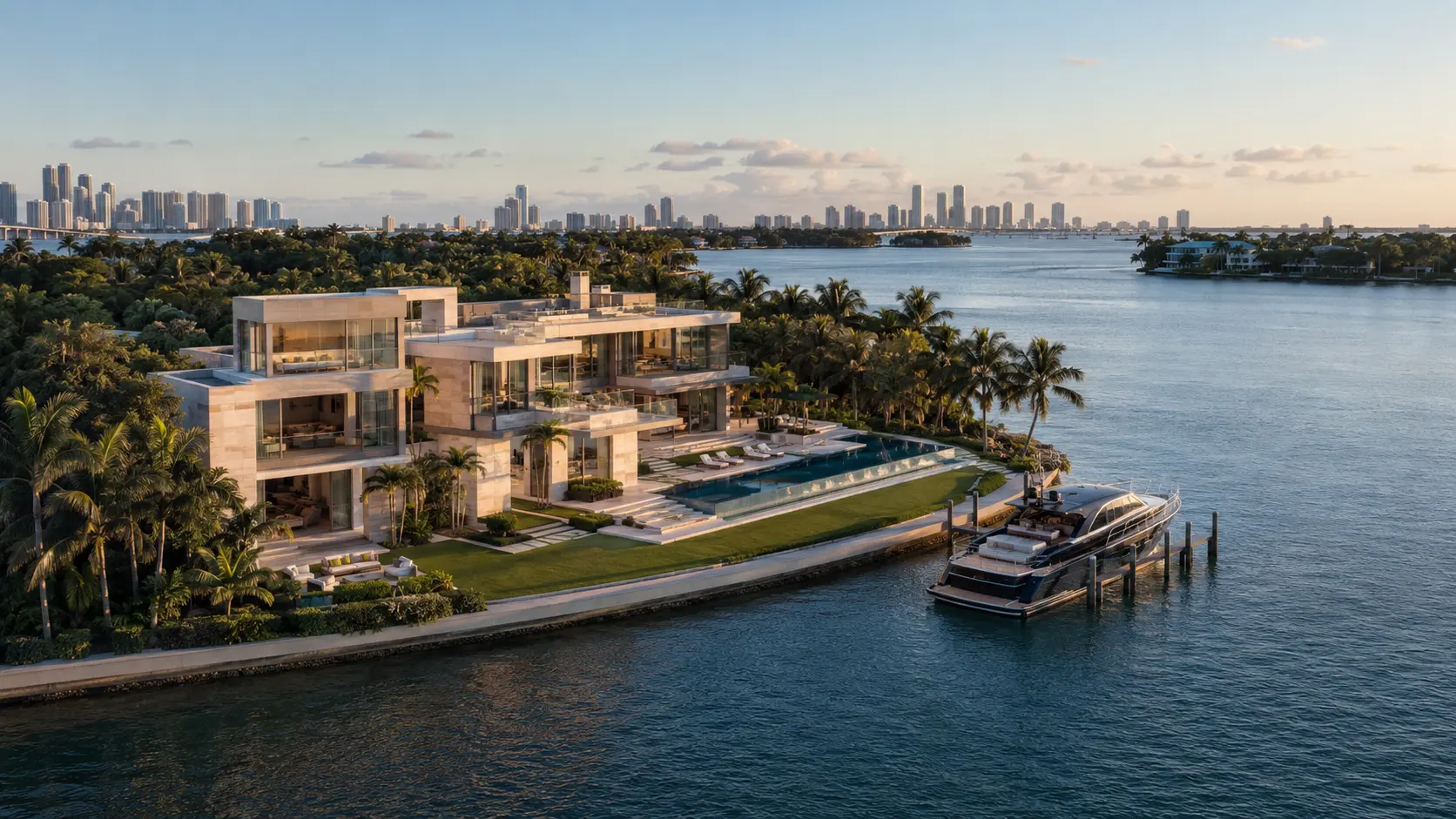
Indian Creek, Star Island and select gated islands represent the most supply-constrained segment. Sales are infrequent, and individual transactions can reset expectations because there are so few comparable properties. Large lots, security and uninterrupted water frontage command premiums unavailable in conventional neighborhoods.
Miami Beach waterfront estates
North Bay Road, the Venetian Islands, Sunset Islands and other Miami Beach enclaves offer a combination of residential privacy and immediate access to restaurants, culture and the urban core. Renovated estates compete with new construction, but land and waterfront dimensions often determine value before finishes do.
Fisher Island and branded condominiums
Fisher Island and a small group of oceanfront or branded developments attract buyers who prefer managed amenities, security and turnkey ownership. At this level, the line between a private home and a hospitality product continues to blur.
Coral Gables and Coconut Grove
Gables Estates, Tahiti Beach, Snapper Creek Lakes and select Coconut Grove waterfront properties offer larger sites, mature landscaping and access to schools and established residential communities. Their appeal expands Miami’s luxury geography beyond Miami Beach.
For a broader comparison of the region’s residential character, see our interactive guide to the best neighborhoods in Miami for 2026.
What the Headline Does Not Mean
Strong journalism separates a striking statistic from an all-purpose market conclusion. Miami’s lead above $30 million does not mean every luxury listing sells quickly, that every condo building is appreciating or that New York has ceased to be a global property capital.
New York’s market remains larger and more diverse by many measures. The Bay Area retains enormous concentrations of technology wealth. Miami’s result describes completed deals at one unusually high price threshold during one six-month period.
Conditions also differ within Miami. Newer, well-capitalized condominium buildings can perform very differently from older properties facing reserve requirements, insurance pressure or major assessments. Waterfront single-family homes are governed by land scarcity, while high-rise units face a more direct comparison with competing inventory.
The countywide market has become more active, but it is not uniformly competitive. Buyers below the trophy tier remain sensitive to mortgage rates, insurance, taxes and association costs. Miami Finance Review’s Florida housing market forecast examines those broader forces through 2030.
Why Ultra-Luxury Sales Matter Beyond Real Estate
A $30 million home purchase is a property transaction, but the resident wealth surrounding it can influence the broader economy. New households may establish family offices, relocate companies, hire local professionals, support philanthropy and allocate capital to regional businesses or development.
The direct real estate impact is also substantial. Trophy properties employ architects, contractors, engineers, designers, security specialists, property managers, brokers, attorneys and tax advisers. Renovation and ongoing operating expenditures can extend for years after a closing.
There are tradeoffs. A larger concentration of private wealth can intensify land competition and contribute to higher service costs. It can also sharpen the divide between the premium property market and the region’s affordability challenges. Miami’s policy task is to convert capital inflows into a broader base of investment, employment and infrastructure rather than treating headline transactions as an end in themselves.
Miami Ultra-Luxury Real Estate Outlook for the Rest of 2026
Miami-Dade needs 10 additional sales above $30 million during the second half to surpass the full-year record of 33 set in 2025. With 24 transactions already completed, a new record is mathematically within reach even if the pace moderates.
The constructive case rests on three durable factors: limited trophy inventory, substantial cash liquidity and Miami’s continuing appeal to domestic and international wealth. The risks are equally clear. Financial-market volatility can change buyer confidence, insurance and ownership costs can influence even affluent purchasers, and a small number of delayed closings can materially alter statistics in such a thin segment.
The most important development is therefore not simply that Miami sold more $30 million homes than New York. It is that Miami’s premium housing market now has sufficient depth to lead a category once associated primarily with Manhattan, the Hamptons, Los Angeles and Silicon Valley.
Miami is no longer asking to be included among America’s principal ultra-luxury markets. In the first half of 2026, buyers placed it at the top.
Frequently Asked Questions
Did Miami overtake New York in luxury real estate?
Miami-Dade overtook New York City in the number of closed residential sales above $30 million during the first half of 2026. The comparison does not mean Miami’s entire housing market is larger than New York’s.
How many Miami homes sold for more than $30 million in 2026?
Twenty-four Miami-Dade condos and single-family homes closed above $30 million during the first six months of 2026, according to Analytics Miami data reported by Bloomberg.
How does Miami compare with New York and the Bay Area?
During the first half of 2026, Miami-Dade recorded 24 sales above $30 million, compared with 17 in New York City and nine in the San Francisco Bay Area.
Why is Miami’s ultra-luxury real estate market growing?
Primary drivers include domestic wealth migration, international demand, Florida’s tax structure, scarce waterfront land, cash-rich buyers and Miami’s expanding finance and business ecosystem.
Are most Miami ultra-luxury homes purchased with cash?
Most Miami-Dade transactions above $30 million during the first half of 2026 were cash purchases. Cash is common at the top of the market because it reduces financing and closing risk.
Which Miami neighborhoods have the most expensive homes?
Miami’s highest-priced properties are concentrated in areas such as Indian Creek, Star Island, North Bay Road, the Venetian and Sunset Islands, Fisher Island, Gables Estates, Tahiti Beach and select Coconut Grove waterfront enclaves.
Will Miami set a new ultra-luxury sales record in 2026?
Miami-Dade completed 24 sales above $30 million in the first half, compared with a full-year record of 33 in 2025. The market is on pace to break the record, but completed sales can vary significantly in this small, high-value segment.
Methodology and Sources
This report uses Analytics Miami transaction data reported by Bloomberg on July 24, 2026; MIAMI REALTORS’ June 2026 market report; and Realtor.com research on cash purchases in Miami’s luxury tiers. The $30 million comparison covers closed residential transactions in Miami-Dade County, New York City and the San Francisco Bay Area during the first half of 2026. “Ultra-luxury” has no single universal threshold; this article uses $30 million because that is the level in the comparative dataset. Transaction counts may be revised as deeds and closed sales are recorded.
Market intelligence. Capital insight. Delivered daily.
Miami Finance Review produces independent editorial analysis. Figures are attributed to their sources and independently cross-checked where possible. This content is informational and is not investment, legal, tax or lending advice.