Answer first: Florida is attracting serious data center interest, but the state is not simply opening a new real estate category. It is testing whether utilities, local governments, landowners and capital providers can coordinate around very large electrical loads. The decisive asset is not raw acreage. It is a site with a credible power-delivery date, an executable utility contract, sufficient water or an alternative cooling plan, fiber redundancy, local approvals and a capital structure that can survive years of development before revenue begins.
That distinction matters in 2026. Florida has a tax framework for qualifying data centers, a new state law governing large-load customers and active utility tariff proceedings. It also has established connectivity infrastructure in South Florida and large development sites elsewhere. Yet each project remains site-specific. A parcel marketed as suitable for a data center may still fail because the requested megawatts cannot arrive on schedule, a substation or transmission upgrade is not funded, water use is constrained, generator noise conflicts with nearby homes, or the end user cannot support the required collateral and long-term commitments.
Key takeaways
- Power is the first underwriting question. A utility feasibility study, interconnection scope and in-service schedule matter more than a general statement that electricity is nearby.
- Florida law now requires minimum tariff and service protections for large-load customers while preserving local authority over planning and land-development decisions.
- Florida’s sales-tax exemption can be valuable, but it applies only to qualifying facilities that meet the statutory capital-investment and critical-load tests.
- Fiber-rich South Florida has a connectivity advantage, while larger inland sites may offer more room for substations, setbacks, stormwater systems and phased expansion.
- The development schedule is a coordinated sequence. Land control, utility engineering, entitlements, water analysis, equipment procurement and financing must advance together.
The national power curve is moving faster than the property market
The demand case begins with electricity. A June 2026 update from Lawrence Berkeley National Laboratory estimates that U.S. data centers could use 649 terawatt-hours of electricity in 2030 in its reference case, equal to 11.8% of total U.S. electricity use. The report’s scenario range is 9.5% to 15.3%, with compounded uncertainty bounds of 521 to 843 terawatt-hours.
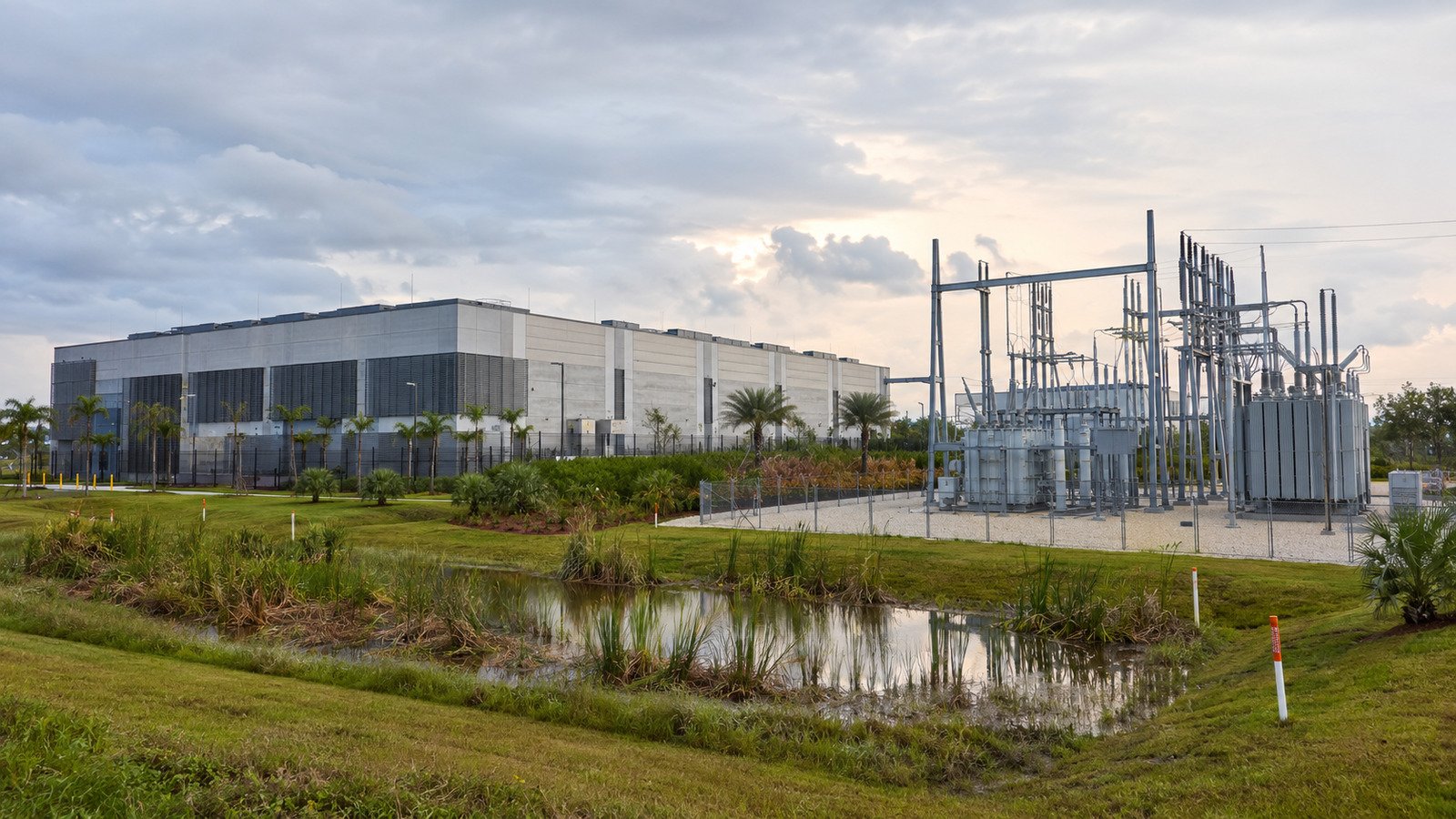
That national forecast does not tell Florida how many campuses will be built. It does explain why utilities increasingly treat data centers as a system-planning issue rather than a conventional commercial connection. A single proposed campus can request hundreds of megawatts, operate at a high load factor and require generation, storage, transmission, substations and distribution upgrades that are larger than the visible building.
MFR calculation: what a large-load request means in annual energy
The following sensitivity is an MFR calculation, not a project forecast or utility quote. It assumes the facility averages 85% of its stated electrical demand across all 8,760 hours in a year. Annual electricity equals demand in megawatts multiplied by 8,760 hours multiplied by 85%.
| Illustrative demand | Average load at 85% | Annual electricity | Illustrative energy spend at 7 cents per kWh |
|---|---|---|---|
| 50 MW | 42.5 MW | 372,300 MWh | $26.1 million |
| 100 MW | 85 MW | 744,600 MWh | $52.1 million |
| 200 MW | 170 MW | 1,489,200 MWh | $104.2 million |
The 7-cent assumption is only a transparent sensitivity input. It is not an available Florida tariff and excludes demand charges, fuel adjustments, taxes, special large-load charges, backup generation, transmission work and other costs. The table’s purpose is to show scale. Doubling contracted demand roughly doubles annual electricity exposure before the developer pays for the building, cooling plant, substations, servers and financing.
This is why Florida data center development cannot be evaluated like a warehouse with an unusually large electric bill. The utility contract can become one of the project’s most important financial documents.
Florida’s 2026 law makes the utility agreement part of the capital stack
CS/CS/SB 484 became Chapter 2026-65 and took effect July 1, 2026, except where the law provides otherwise. The measure preserves local-government authority over comprehensive planning and land-development regulations for large-load customers. It also requires public utilities to provide minimum tariff and service requirements for those customers, addresses consumptive-use permits for large-scale data centers and directs a state study of data center construction and operations.
The practical message is that a statewide policy does not preempt local site review, and a local zoning approval does not guarantee power. Both tracks must work.
Florida Power & Light described its approved large-load framework in a January 8, 2026 company Q&A. FPL said a large-load customer must fund an engineering study that evaluates feasibility, connection cost and the date the utility can meet the requested demand. The company also described an incremental generation charge, a minimum take-or-pay demand charge, credit-linked collateral, a 20-year minimum contract term and an early-exit fee. Those are FPL’s descriptions of its tariff protections, not universal terms for every Florida utility.
Duke Energy Florida’s proposed large-load tariff remained in an open Florida Public Service Commission docket as of early September 2026. The existence of separate utility proceedings reinforces the point: developers must underwrite the actual service territory, tariff, system study and contract, not a statewide average.
The tax exemption is meaningful, but the threshold is a development test
Florida’s data center sales-tax exemption covers qualifying data center property, including electricity used exclusively at a qualifying data center. The statute requires at least $150 million in cumulative capital investment and a critical IT load of at least 100 megawatts, with at least 1 megawatt dedicated to each individual owner or tenant. Those requirements generally must be satisfied within five years after construction begins.
The exemption improves the economics of a facility that reaches the statutory threshold. It does not solve the conditions required to reach it. The developer still needs a site plan, utility schedule, construction budget, tenant or owner commitment, and enough capital to carry the project through a long pre-revenue period.
For context on the state’s broader growth platform, MFR’s analysis of Florida’s $1.8 trillion economy examines the population, capital and real estate forces supporting new infrastructure investment.
Land is necessary, but development-ready land is a bundle of permissions
A data center campus needs more than an industrial land-use designation. The usable site must accommodate electrical yards, transformers, switchgear, cooling equipment, backup generators, fuel systems, security, stormwater, loading, setbacks and future phases. Flood elevation, wetland impacts, soil conditions and access roads can change both the site plan and the budget.
Palm Beach County’s official zoning record for Project Tango at Central Park Commerce Center illustrates the scale of local review. County materials describe multiple applications affecting a 202.67-acre property. An April 27, 2026 revision showed 1.032 million square feet of data and information processing use, while a later pre-application concept requested replacement of planned warehouse space and described 1.357 million square feet of data center uses. Those figures represent separate stages of the review record, not a completed campus or a final power allocation.
Nearby residential uses can introduce additional questions. Generator testing, mechanical noise, lighting, construction traffic and visual screening all need enforceable plans. Florida’s 2026 law expressly leaves land-development authority with local governments, so community compatibility remains part of the development case.
Water and cooling belong in the first site screen
Cooling design changes a project’s water and power profile. An air-cooled or hybrid system may reduce water demand but increase electricity use or equipment needs under certain conditions. An evaporative system may improve efficiency while creating a larger water-supply and discharge question. Reclaimed-water availability, water quality, seasonal limits and drought conditions can change the answer.
Florida’s 2026 legislation added specific consumptive-use permitting provisions for large-scale data centers. Developers should therefore identify the cooling strategy, expected annual and peak water demand, source, backup source and discharge plan before closing on land. A generic utility-availability letter is not a substitute for a permitted volume and a site-specific engineering design.
Fiber favors South Florida, but latency is only one variable
South Florida already has an interconnection market. Equinix lists facilities in Miami, Doral and Boca Raton, including its MI1 carrier-neutral facility. That established ecosystem supports network density, cloud access and regional connectivity.
Connectivity does not automatically make urban Miami the best home for a very large campus. Dense sites can face higher land costs, tighter generator and substation setbacks, flood exposure and fewer options for phased expansion. The likely Florida pattern is more specialized: network-dense facilities in South Florida, paired with larger campus opportunities where utilities can serve high loads and land can absorb the infrastructure footprint.
That division resembles the broader contrast in Miami commercial property. MFR’s 2026 commercial real estate outlook shows why property type alone does not determine performance. Location, operating requirements and capital structure do.
A seven-part underwriting framework
| Workstream | Evidence required before land closing | Failure mode |
|---|---|---|
| Power | Utility study scope, requested load, phasing, upgrade cost, tariff and credible in-service dates | Land closes before capacity or timing is known |
| Customer credit | Executed commitment, load ramp, collateral support and remedies for delay or exit | Infrastructure is built for a speculative load |
| Land and zoning | Permitted use, setbacks, height, generator testing, noise, access and expansion rights | Site area is consumed by infrastructure or conditions |
| Water and cooling | Cooling concept, annual and peak demand, permit path, source and discharge plan | Late redesign raises power use or delays approvals |
| Fiber | Two physically diverse routes, carrier commitments and tested delivery schedule | Nominal redundancy shares one vulnerable path |
| Resilience | Flood elevation, wind design, drainage, fuel continuity and recovery plan | A code-compliant building lacks operational continuity |
| Capital | Phase budget, contingencies, equipment deposits, interest carry and completion support | Cost growth appears before contracted revenue |
The framework turns a broad Florida growth story into a set of documents that can be verified. Each workstream has an owner, a deadline and a condition that should appear in the land contract, utility agreement, tenant documents or financing package.
Capital intensity changes the order of operations
In ordinary commercial development, the land, vertical construction and tenant-improvement budgets can often be separated. In a large data center, the utility and equipment commitments may require major payments before the building produces income. Long-lead electrical gear can force procurement decisions while design and permitting are still moving. A phased campus also needs a clear rule for which shared infrastructure is funded in the first phase and how later phases reimburse it.
The financing analysis should distinguish three risks:
- Development risk: Can the team obtain approvals and deliver the physical facility?
- Power risk: Can the utility provide the contracted capacity on the required schedule and cost basis?
- Absorption and credit risk: Will the user take and pay for the capacity after the infrastructure is built?
A strong guarantor may reduce the third risk but cannot eliminate the first two. Likewise, a utility study can support a power plan without proving a tenant will occupy the campus. The capital structure needs separate protections for each failure mode.
MFR’s guide to Florida construction financing explains why land basis, cost controls and draw sequencing matter before vertical work begins. The current improvement in commercial real estate lending may increase available capital, but data center underwriting still depends on the utility and customer contracts.
Resilience must be operational, not just structural
Florida facilities must account for wind, flood, heat, heavy rainfall and potential fuel or transportation disruption. Building-code compliance is the starting point. Operational resilience also asks whether redundant systems share the same flood elevation, whether fuel deliveries can reach the site after a storm, how long cooling can operate during a grid interruption and whether both fiber paths cross the same vulnerable corridor.
Those questions should be tested against the actual parcel. MFR’s analysis of Florida hurricane-season closing risks explains why flood zones, insurance and post-storm access can affect transaction timing even when a property is not physically damaged.
The development sequence that reduces false starts
- Define the load: document the IT demand, ramp schedule, redundancy level and flexibility.
- Control land conditionally: tie closing rights to utility, zoning, environmental, water and access findings.
- Fund utility engineering: obtain a site-specific scope, cost allocation and in-service schedule.
- Run parallel approvals: advance zoning, water, stormwater, noise, generator, fuel and transportation reviews.
- Lock the customer obligations: align load, term, collateral, delay remedies and exit costs with the utility commitment.
- Procure critical equipment: match deposits and delivery dates to approved design and financing milestones.
- Close construction capital: fund the complete first-phase infrastructure, contingency and carry, not only the visible building.
The sequence is not perfectly linear. The point is coordination. If land control, utility work, entitlements and capital move independently, the project can spend heavily without creating a financeable campus.
The bottom line
Florida has real ingredients for data center growth: a large economy, expanding business base, established connectivity, significant land options and a statutory tax incentive for qualifying facilities. The 2026 policy changes also give utilities and local governments a clearer framework for evaluating large-load proposals.
But the market should resist equating announcements with deliverable capacity. The investable Florida site is the one that can document when power arrives, who pays for the infrastructure, how water and cooling are managed, which approvals remain, how the campus performs through Florida weather and which credit supports the long-term load.
Land control, utility coordination and financing must advance together. That is the capital constraint behind Florida’s data center opportunity.
Methodology and source note
MFR reviewed the June 2026 Lawrence Berkeley National Laboratory data center energy update, Florida’s 2026 data center legislation, the 2026 Florida Statutes, Florida Public Service Commission records, Florida Power & Light’s published description of its large-load protections, Palm Beach County zoning materials and operator information on South Florida interconnection facilities. The energy table is an original MFR sensitivity using 8,760 annual hours, an 85% average load factor and an illustrative 7-cent-per-kilowatt-hour energy input. It is not a tariff, appraisal, feasibility study or forecast for a specific project.
Frequently asked questions
Why is Florida attracting data center development?
Florida combines population and business growth, established South Florida connectivity, large development sites, utility investment and a sales-tax exemption for qualifying facilities. Those advantages support interest, but they do not guarantee that any specific site has sufficient power, water, approvals or fiber.
What is the biggest constraint on Florida data center development?
For large campuses, the central constraint is usually deliverable electricity on a reliable schedule and an acceptable contract. Land, zoning, water, fiber, equipment and financing remain necessary, but none can substitute for site-specific utility capacity.
How much electricity does a 100 MW data center use?
At an illustrative 85% average load, a 100 MW facility would use about 744,600 megawatt-hours in a year. Actual use depends on occupancy, equipment, cooling, power-use efficiency and operating conditions.
What did Florida’s 2026 data center law change?
The law preserved local authority over planning and land-development regulations, required minimum utility tariff and service protections for large-load customers, added water-permitting provisions for large-scale data centers and directed a state study.
Is Miami the best Florida location for a hyperscale data center?
Not automatically. Miami offers strong connectivity and an established interconnection market, but very large campuses also need land, substations, generator setbacks, stormwater capacity, resilience and room to expand. Some projects may favor South Florida network nodes while placing larger infrastructure on inland or Treasure Coast sites.
What should a landowner verify before marketing a Florida site for data centers?
Verify the utility service territory, available and planned capacity, study process, upgrade cost and timing, permitted use, setbacks, flood and wetland conditions, water and cooling options, physically diverse fiber routes, access, noise limits and expansion area. A nearby transmission line alone does not prove the site can serve a large load.
Market intelligence. Capital insight. Delivered daily.
Miami Finance Review produces independent editorial analysis. Figures are attributed to their sources and independently cross-checked where possible. This content is informational and is not investment, legal, tax or lending advice.