The FAT Village Fort Lauderdale development is positioning the city for a new phase of urban growth. The roughly $500 million redevelopment will turn 5.6 acres in Flagler Village into a walkable district with residences, restaurants, entertainment, public art and South Florida’s first mass-timber office building. The current master plan calls for about 900,000 square feet, 858 residential units, 83,600 square feet of food, beverage and entertainment space, and 176,700 square feet of Class AA office space. First components are being marketed for arrival in 2026, while Hines lists a first-phase completion target of early 2027.
Key takeaways
- FAT Village is a 5.6-acre mixed-use redevelopment led by Hines and Urban Street Development in Fort Lauderdale’s Flagler Village neighborhood.
- The current master plan totals about 900,000 square feet with 858 residences, 83,600 square feet of dining and entertainment space, and 176,700 square feet of Class AA office space.
- The first phase centers on 600 apartments in two towers plus a six-story mass-timber office building and ground-floor commercial space.
- Transit is central to the investment thesis. The site is two blocks from Brightline’s Fort Lauderdale station and is planned around shaded sidewalks, active storefronts and internal pedestrian connections.
- The project is an important office-market test. T3 FAT Village offers a differentiated workplace product at a time when tenants are concentrating demand in newer, amenity-rich buildings.
- The schedule deserves careful reading. The project website says Phase I is arriving in 2026, while Hines’ property profile targets first-phase completion in the first quarter of 2027.
Project status: Under construction as of July 29, 2026. Figures reflect the latest public materials from FAT Village, Hines and DLR Group. Development programs and delivery dates can change as construction and leasing progress.
FAT Village Fort Lauderdale project facts
| Project element | Current public plan | Why it matters |
|---|---|---|
| Site | 5.6 acres in Flagler Village | A four-block redevelopment near downtown Fort Lauderdale |
| Total program | Approximately 900,000 square feet | Large enough to function as a district, not a single building |
| Residential | 858 units across three towers in the master plan | Adds a substantial base of residents to support shops and restaurants |
| Phase I housing | About 600 units in two towers | Creates immediate evening and weekend activity |
| Office | 176,700 square feet of Class AA space | Introduces a differentiated mass-timber workplace to Broward County |
| Dining and entertainment | 83,600 square feet | Supports an all-day destination rather than a residential enclave |
| Transit | Two blocks from Brightline | Connects the site with Miami, West Palm Beach and Orlando |
| Delivery | Initial openings marketed for 2026, with first-phase completion targeted for early 2027 | Creates a near-term leasing and absorption test |
Sources: FAT Village, Hines and DLR Group. The current project website describes the full master plan, while Hines separately details the first phase and later phase.
What is FAT Village in Fort Lauderdale?
FAT Village, short for Food Art Technology Village, is the large-scale redevelopment of a former warehouse and arts district immediately north of downtown Fort Lauderdale. Hines and local developer Urban Street Development are leading the project with Cresset Real Estate, Las Americas, Hudson Capital and Halmos Holdings.
The development sits along North Andrews Avenue between Fifth Street and Sistrunk Boulevard. That location places it between the traditional Las Olas business core, Flagler Village’s apartment base and the Brightline station. It is a strategic piece of urban infill in a South Florida market where well-located assembled land is increasingly difficult and expensive to secure. Miami Finance Review’s analysis of South Florida land prices and assemblage economics explains why controlling a multi-block site can be a competitive advantage before vertical construction begins.
FAT Village is also notable for its scale. A single apartment tower can add residents, but a coordinated district can create its own demand loop. Housing supports restaurants and services. Office users increase weekday traffic. Entertainment extends activity into evenings. Public spaces and cultural programming give people a reason to stay instead of simply passing through.
That combination is the project’s central bet: a dense, connected district can produce more value than a collection of isolated buildings.
Inside the FAT Village development plan
Housing creates the daily customer base
The first phase is planned to deliver roughly 600 rental units in two residential towers. Hines’ broader property profile describes a later phase that would add about 250 units, while the current FAT Village website lists 858 residences across three towers in the full plan.
Those apartments are not merely one component among several. They are the economic foundation for the district’s ground-floor businesses. Hundreds of households can generate repeat demand for coffee, groceries, fitness, restaurants and services throughout the week. That resident base reduces the project’s dependence on destination traffic alone.
Hines has also said that 40 percent of the residential units are intended to be sized and priced to increase financial accessibility. That is an important design choice in a region where new urban housing often targets only the top of the market. It does not solve Broward County’s affordability challenge, but a broader unit mix can support a more durable neighborhood and a more reliable workforce for nearby employers.
The timing is constructive for well-capitalized developers. National housing-start data have been volatile, yet recent figures show why the multifamily construction cycle requires local analysis. New supply can pressure rents during lease-up, but Fort Lauderdale continues to benefit from employment growth, business formation and access to the larger South Florida labor market. The decisive questions will be absorption pace, concessions and the rent premium residents are willing to pay for a walkable location.
T3 FAT Village is a test of the next office cycle
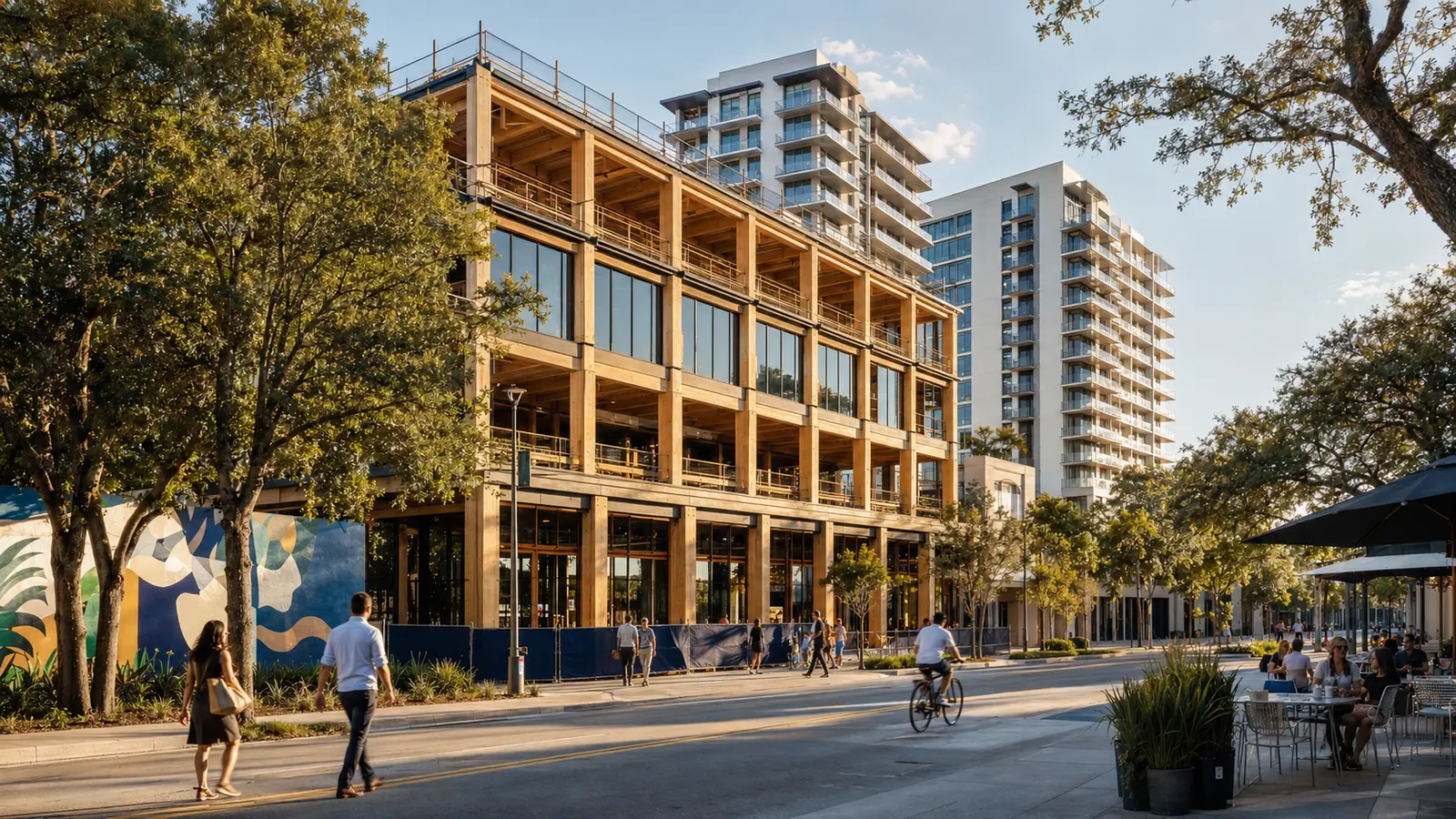
The six-story T3 FAT Village building is the project’s most distinctive component. T3 stands for timber, transit and technology. DLR Group designed nearly 180,000 square feet of creative office space around an exposed mass-timber structure, large windows, outdoor areas, fitness and bicycle amenities, and flexible floor plates.
The building topped out in October 2025 and is scheduled for completion in 2026. It is targeting LEED Gold, WELL and WiredScore Platinum certifications. Hines says the timber design is expected to avoid 694 metric tons of carbon dioxide compared with a concrete structure and store 1,749 metric tons of carbon dioxide in the building.
This is more than an architectural story. It is a live test of how office demand has changed. Companies signing new leases are increasingly selective about location, building quality, wellness features and the experience offered to employees. Older commodity offices may face weaker demand even when newer, highly differentiated space performs well. T3 FAT Village is designed for that narrower but potentially valuable segment of the market.
The risk is equally clear. New office construction is expensive, tenant decisions take time and a premium building still needs signed leases. The project therefore offers a useful indicator for whether Fort Lauderdale can attract technology, legal, financial and professional-services firms that want a South Florida address without paying Miami’s highest occupancy costs.
Broward County’s broader business pipeline provides support for that thesis. The Greater Fort Lauderdale Alliance reported more than $272 million in capital investment from assisted relocations and expansions during the first part of its 2026 fiscal year. That figure is not a direct forecast for FAT Village, but it shows that office demand is being reinforced by real business activity rather than residential growth alone.
Retail, restaurants and culture make the project a district
The current plan includes 83,600 square feet of upscale restaurants and entertainment. Hines’ phase-specific profile lists 73,000 square feet of food, beverage, shopping, entertainment, studios and galleries in the initial phase, followed by additional street-level retail in a later phase.
The distinction matters because retail success depends on sequencing. Opening too much space before the apartments and offices are occupied can create visible vacancies. Opening too little can make the development feel unfinished and reduce the premium attached to the residences and workplaces. The strongest outcome is a coordinated opening in which residents, employees and visitors begin supporting the commercial space at roughly the same time.
Preserving the identity of the original arts district is another test. Hines has said that half of the project’s discounted retail space will be made available to artists and art-related tenants. Murals, galleries and maker spaces can preserve continuity, but the long-term result will depend on leasing decisions and ongoing programming after construction is complete.
Why the location strengthens the investment case
FAT Village is two blocks from Brightline’s Fort Lauderdale station. That proximity links the district with Miami, West Palm Beach and Orlando and gives residents and office users an alternative to driving for some regional trips.
Transit access alone does not make a project transit-oriented. The blocks between the station and the buildings also need to be comfortable, legible and active. FAT Village’s plan emphasizes wide sidewalks, shade trees, storefronts, internal paseos and gathering spaces. The City of Fort Lauderdale is separately developing a mobility master plan for the Northwest-Progresso-Flagler area that includes Flagler Village and considers walking, cycling, transit and driving together.
For development economics, better connectivity can widen the customer and employee base. A company in FAT Village can recruit from multiple South Florida counties. A restaurant can serve office workers, nearby residents and rail passengers. A renter can live in Fort Lauderdale while maintaining professional ties in Miami or Palm Beach County.
This regional access helps explain why development is no longer concentrated in one South Florida downtown. Miami remains the region’s largest urban market, and the Miami development pipeline continues to attract global capital. Fort Lauderdale, however, can compete on a different combination of accessibility, relative cost, quality of life and available development sites.
What FAT Village says about South Florida development in 2026
Capital is available, but it is selective
Hines announced that the project secured a $220 million construction loan before its 2024 groundbreaking. That financing is meaningful in a cycle defined by higher borrowing costs, conservative underwriting and greater scrutiny of sponsor equity.
The lesson is not that every mixed-use project can obtain capital. It is that lenders and investors will still fund large developments when the site, sponsorship, capital stack and execution plan are strong. Miami Finance Review recently found that commercial real estate lending is recovering, although capital remains far more discriminating than it was during the lowest-rate years.
For developers preparing a similar project, the financing package must address construction risk, interest carry, lease-up assumptions, cost contingencies and the timing of each use. The required materials are outlined in our South Florida development financing checklist.
Mixed-use can reduce reliance on a single demand source
A project with apartments, offices, restaurants and public space has operational complexity, but it also has diversification. Weakness in one use does not automatically determine the performance of the entire district. Residential occupancy can support retail while office leasing matures. Successful dining can strengthen the project’s brand and help apartment retention. A differentiated office building can attract daytime spending and corporate visibility.
The model works only when each component is independently viable. Mixed-use is not a substitute for underwriting. It is a way to create complementary demand when the uses, phasing and public realm are designed coherently.
Construction discipline remains essential
FAT Village is moving through construction at a time when some material-cost pressures have eased, yet labor, insurance, permitting and schedule risks remain significant. Our review of South Florida construction costs in 2026 found that a cooler pricing environment does not necessarily translate into easy delivery.
Mass timber adds another layer of coordination because structural components, fire protection, building systems and finish quality must be integrated precisely. It can also offer construction and sustainability advantages when design, procurement and assembly are handled by an experienced team.
The most important risks to watch
FAT Village has a compelling location and an unusually differentiated program, but the investment case still depends on execution. Four indicators will show whether the project is meeting its promise:
- Apartment absorption. Watch the pace of signed leases, effective rents and concessions as the first 600 units enter the market.
- Office commitments. Tenant names, square footage leased and lease terms will be the best evidence that the T3 concept can command a premium in Fort Lauderdale.
- Retail curation. A balanced mix of daily-needs businesses, destination restaurants and arts uses will matter more than the raw square-foot total.
- Delivery sequencing. Streets, landscaping and ground-floor space need to feel complete as residents and tenants arrive. A fragmented opening could delay the district effect.
There is also a broader cycle risk. Higher-for-longer interest rates can pressure refinancing and required returns. New apartment deliveries can increase competition. Office tenants can delay decisions. These are normal development risks, not evidence that the project thesis is broken. They are the variables that determine how quickly value is realized.
The Florida opportunity behind FAT Village
FAT Village reflects a constructive evolution in Florida development. The state is moving beyond isolated towers toward connected urban districts that combine housing, employment, dining, culture and transportation. That is a more resilient model for cities competing for talent and private investment.
Fort Lauderdale occupies a strategic position in that shift. It sits between Miami and Palm Beach County, has direct rail access to both, and can offer companies and households an urban environment at a different scale. The city’s challenge is to convert those advantages into complete neighborhoods without erasing the culture that made those neighborhoods attractive.
If FAT Village leases successfully and its public spaces remain active, it could become a repeatable model for South Florida infill: assemble land near transit, mix complementary uses, invest in the street level and give the project an identity stronger than any individual building.
That outcome is not guaranteed. But the project has the ingredients that capital is rewarding in 2026: experienced sponsorship, a difficult-to-replicate site, multiple demand drivers, transit access and a product designed for the way people now choose where to live and work. It is a significant vote of confidence in Fort Lauderdale’s next chapter and in Florida’s continued capacity to turn population and business growth into durable urban development.
Frequently asked questions
What is FAT Village in Fort Lauderdale?
FAT Village is a mixed-use redevelopment in Fort Lauderdale’s Flagler Village neighborhood. Its name stands for Food Art Technology Village. The plan combines residences, office space, restaurants, entertainment, public art and community spaces across approximately 5.6 acres.
How large is the FAT Village development?
The current project website describes a roughly 900,000-square-foot master plan with 858 residential units, 83,600 square feet of food, beverage and entertainment space, and 176,700 square feet of Class AA office space.
When will FAT Village open?
The project website markets Phase I as arriving in 2026. Hines’ property profile lists a first-phase completion target of the first quarter of 2027. Individual residential, office and retail components may open on different dates.
Who is developing FAT Village?
Hines and Urban Street Development are leading the project with Cresset Real Estate, Las Americas, Hudson Capital and Halmos Holdings.
What is T3 FAT Village?
T3 FAT Village is a six-story, approximately 180,000-square-foot Class AA office building built with a mass-timber structure. T3 stands for timber, transit and technology. The building is targeting LEED Gold, WELL and WiredScore Platinum certifications.
Is FAT Village close to Brightline?
Yes. Hines states that FAT Village is two blocks from Brightline’s Fort Lauderdale station, which connects the city with Miami, West Palm Beach and Orlando.
Sources and methodology
Miami Finance Review reviewed the current FAT Village project website, Hines’ property profile and construction announcements, DLR Group’s project description, the City of Fort Lauderdale’s mobility-planning materials and the Greater Fort Lauderdale Alliance’s 2026 economic-development update. Project figures are attributed to the most recent official source available. Where official pages publish different timelines or phase totals, the article identifies the difference instead of selecting one figure without explanation.
- FAT Village: current master plan and Phase I positioning
- Hines: FAT Village property profile and phase details
- Hines: construction start and $220 million construction loan
- Hines: T3 FAT Village topping-out announcement
- DLR Group: T3 FAT Village design and certification targets
- Hines: sustainability, residential-accessibility and artist-space targets
- City of Fort Lauderdale: Northwest-Progresso-Flagler mobility planning
- Greater Fort Lauderdale Alliance: 2026 capital-investment and expansion update
Editorial note: Miami Finance Review is an independent publication. This article is for informational purposes and does not constitute investment, legal, tax or lending advice. Miami Finance Review has no disclosed financial interest in the project.
Market intelligence. Capital insight. Delivered daily.
Miami Finance Review produces independent editorial analysis. Figures are attributed to their sources and independently cross-checked where possible. This content is informational and is not investment, legal, tax or lending advice.