Published July 22, 2026. This analysis uses the latest operating, cargo, passenger, credit-rating and capital-program information released by Miami International Airport and Miami-Dade County.
Miami International Airport’s economic impact has reached a record $212 billion in statewide business revenue, establishing MIA as one of Florida’s most powerful engines of trade, tourism and employment. The airport’s newly released impact study estimates that activity connected to MIA supports 945,682 direct, indirect, induced and related jobs across Florida. Those totals rose 17% and 12%, respectively, as cargo volume set a sixth consecutive annual record and passenger traffic remained above 55 million.
The growth is not limited to more flights. MIA is now the busiest cargo airport in the United States and the third busiest globally, behind only Hong Kong and Shanghai. Its 2025 airfreight trade value reached $89 billion for origin-and-destination cargo, while freight growth continued into the first quarter of 2026. At the same time, Miami-Dade is advancing an airport-wide capital and maintenance program that it now describes as a $14 billion investment.
This makes MIA a useful lens through which to understand Miami’s next economic phase. The airport connects international commerce, industrial property, hotels, construction, retail, pharmaceuticals, perishables and corporate relocation. Its expansion is both a result of Miami’s growth and infrastructure intended to support more of it.
This analysis expands Miami Finance Review’s coverage of South Florida industrial real estate, companies moving to Miami and the Miami commercial real estate outlook.
Key Takeaways
- Record economic impact: MIA’s estimated statewide business-revenue impact increased 17% to $212 billion.
- Employment reach: The airport impact study estimates 945,682 direct, indirect, induced and related jobs, up 12% from the prior study.
- Cargo leadership: MIA handled nearly 3.5 million tons of freight in 2025, rising 13.6% for a sixth consecutive annual record.
- Global ranking: The airport ranks first in the United States and third worldwide for cargo under the latest rankings cited by MIA.
- Passenger scale: MIA served 55.3 million passengers in 2025 and remained the country’s second-busiest airport for international travelers.
- Investment cycle: Miami-Dade describes the broader airport capital and maintenance program as a $14 billion investment, including terminal, gate, hotel and operating-system upgrades.
- Credit strength: Fitch, KBRA and S&P issued investment-grade ratings on MIA’s 2026 aviation revenue refunding bonds, with positive outlooks from Fitch and KBRA.
Miami International Airport Economic Impact: 2026 Dashboard
| Indicator | Latest reading | Change or ranking | What it means |
|---|---|---|---|
| Statewide business-revenue impact | $212 billion | Up 17% | Trade, travel and airport-linked activity reach far beyond the terminal |
| Jobs supported | 945,682 | Up 12% | Includes direct, indirect, induced and related employment statewide |
| Airfreight | Nearly 3.5 million tons | Up 13.6% in 2025 | Sixth consecutive annual cargo record |
| Cargo ranking | No. 1 U.S.; No. 3 global | Highest global position reported by MIA | Miami operates as an international distribution hub, not only a local gateway |
| Origin-and-destination airfreight trade | $89 billion | Up 8.2% | Shows the value of goods beginning or ending their air journey in Miami |
| Passengers | 55.3 million | Above 55 million for a second year | Sustains tourism, hospitality, retail and airline demand |
| Airport investment | Up to $14 billion | More than 200 projects | Adds gates, terminal capacity, technology and construction activity |
How MIA Reached a Record $212 Billion Economic Impact
The latest impact study was prepared for Miami International Airport by Martin Associates using 2025 operating activity. MIA reported that its estimated statewide business revenue increased by $31 billion from the prior study. The supported-employment estimate rose by more than 100,000 positions when direct, indirect, induced and related activity is included.
Three engines explain the increase. First, cargo volume accelerated sharply. Second, passenger traffic remained near its record level even as North American domestic air travel softened. Third, the airport’s role as a connecting hub expanded, allowing goods and travelers that do not begin or end in Miami to generate local handling, service and logistics activity.
The breadth matters. A shipment moving through MIA can generate revenue for an airline, ground handler, freight forwarder, customs broker, cold-storage operator, trucker and warehouse. Passenger traffic reaches hotels, restaurants, rental-car operators, retailers and convention businesses. Airport construction supports contractors, engineers, architects and suppliers. Employee spending then circulates through the regional economy.
The $212 billion figure should not be confused with Miami-Dade’s gross domestic product or with revenue collected by the airport itself. It is an economic-impact estimate of statewide business revenue connected to airport activity. That distinction makes the number more credible, not less meaningful: it shows how a global transportation hub transmits demand through multiple Florida industries.
MIA Is Now America’s Leading Cargo Airport
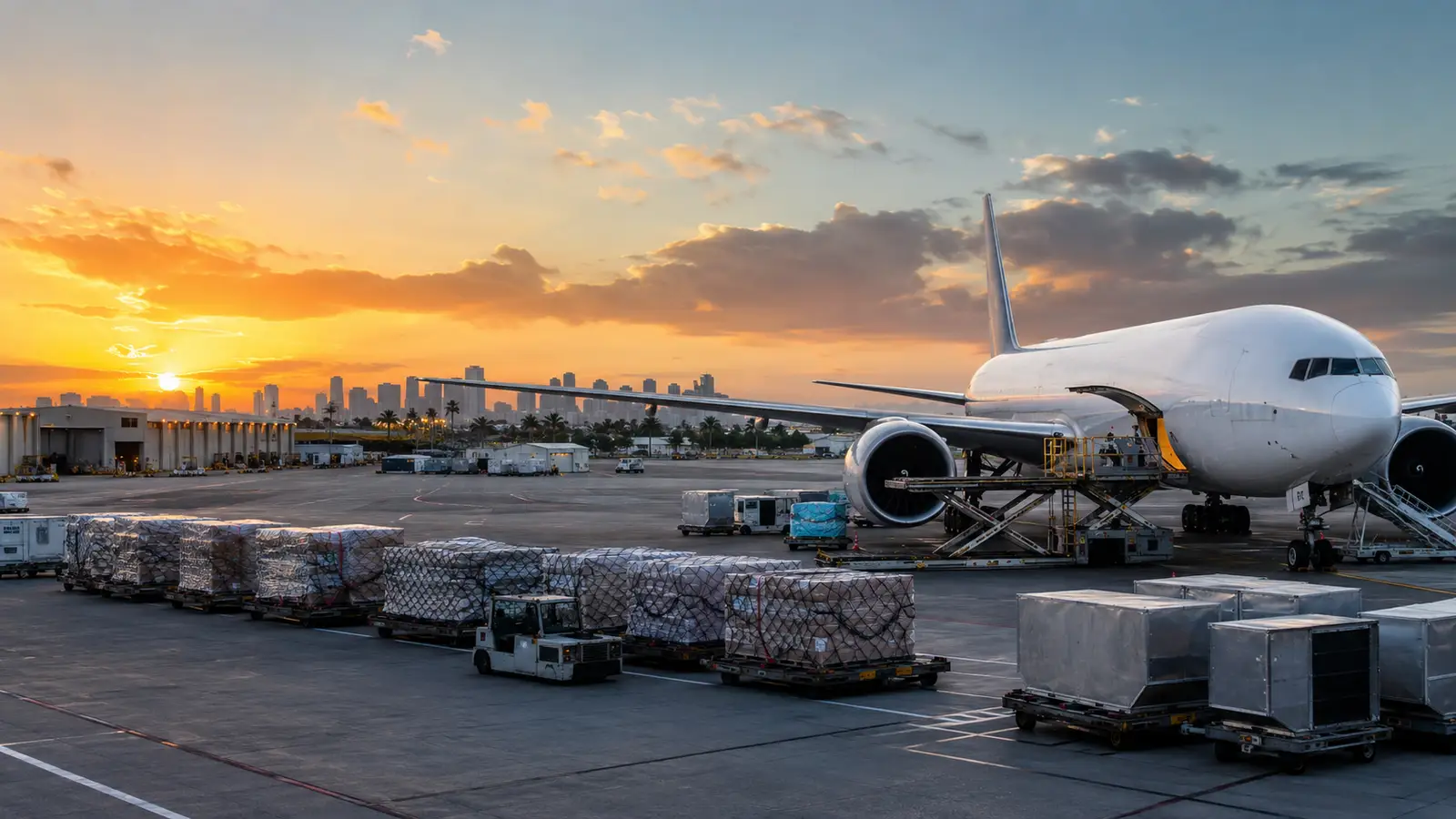
Cargo is the clearest growth story. Freight shipments increased 13.6% in 2025 to nearly 3.5 million tons, marking six straight record years. The latest international rankings cited by MIA place it first in the United States and third in the world for cargo. Freight growth carried into 2026, with first-quarter shipments rising 15.7% from a year earlier.
MIA’s location gives it a structural advantage. The airport offers more flights to Latin America and the Caribbean than any other U.S. airport, and 85% of its freight is international. Miami is therefore a natural transfer point between producers, consumers and distribution networks in the Americas, Europe and Asia.
The composition of traffic also shows a stronger hub function. MIA reported that in-transit freight exceeded origin-and-destination freight for the first time in more than a decade, creating a 55% in-transit and 45% origin-and-destination split. Connecting cargo creates handling and logistics demand even when Miami is not the shipment’s final market.
| Cargo indicator | 2025 reading | Investment significance |
|---|---|---|
| Total airfreight | Approximately 3.4–3.5 million tons | Supports cargo facilities, trucking, warehousing and specialized handling |
| O&D trade value | $89 billion | Measures high-value goods beginning or ending their air journey at MIA |
| International share | 85% | Reinforces Miami’s global trade specialization |
| In-transit share | 55% | Signals that MIA is increasingly functioning as a transfer hub |
| Cargo-carrier base | More than 35 all-cargo carriers | Provides route diversity and logistics options |
What Moves Through Miami’s Air-Cargo Gateway
Miami’s cargo advantage is not built on one commodity. MIA handles perishables, pharmaceuticals, medical equipment, e-commerce parcels and high-technology goods. These categories reward speed, temperature control, security and dependable international connections—services that air cargo can provide even when ocean transport is less expensive.
Perishables are especially important because South Florida connects Latin American agricultural production with U.S. consumers. Flowers, seafood, fruits and vegetables require cold-chain infrastructure and rapid inspection. A $141 million phytosanitary treatment and cold-chain processing facility under development near MIA and PortMiami is designed to expand that capability when it opens, currently targeted for 2027.
Pharmaceutical logistics provide another higher-value layer. Temperature-controlled medical freight requires specialized facilities, validated procedures and reliable connections. Those requirements create demand for technical operators and modern industrial space rather than commodity storage alone.
The result is an industrial ecosystem that is difficult to duplicate. The airport, PortMiami, highway access, customs expertise and a multilingual workforce operate together. That ecosystem helps explain why South Florida industrial real estate has remained strategically important even when broader commercial-property activity slows.
Fifty-Five Million Passengers Strengthen Tourism and Hospitality
MIA served 55.3 million passengers in 2025, its second consecutive year above 55 million. The total was approximately 1% below the airport’s 2024 record, yet it was strong enough to move MIA to eighth among U.S. airports for passengers. MIA remained second nationally for international passenger traffic.
The mix included approximately 24.8 million international and 30.5 million domestic passengers. MIA also estimates that about 60% of Florida’s international visitors arrive through the airport. That flow supports hotels, restaurants, cruise travel, retail, entertainment and business conventions throughout South Florida.
Passenger connectivity also matters to corporate growth. Executives evaluating Miami as a headquarters or regional office can reach Latin America, the Caribbean and major U.S. markets through a single hub. The airport’s network therefore complements the business-migration trends examined in Companies Moving to Miami in 2026.
MIA’s performance is particularly notable because its 2025 passenger total remained close to a record while North American domestic air travel declined. Miami’s international exposure, major-event calendar and position as a cruise gateway helped diversify demand.
A Major Airport Investment Cycle Is Underway
Miami-Dade now describes the airport’s broader capital-improvement and maintenance investment as reaching $14 billion. The core Modernization in Action program has also been cited at $9 billion on individual project pages. The difference reflects how the county groups the underlying maintenance, expansion and related capital initiatives; readers should not add the figures together.
The investment is intended to prepare MIA for more than 77 million annual travelers and at least four million tons of freight by 2040. Major projects include terminal redevelopment, gate expansion, a new concourse, a hotel, baggage systems, parking and modernization of elevators, escalators, moving walkways and restrooms.
| Project | Reported scope | Target timing |
|---|---|---|
| Gate D60 expansion | Approximately $1 billion; 17 upgraded contact gates, passenger areas, retail and baggage improvements | Completion targeted for 2030 |
| Concourse K | Approximately $600.6 million; South Terminal expansion with six new passenger gates | Completion targeted for spring 2029 |
| Central Terminal redevelopment | Approximately $745 million to modernize MIA’s oldest terminal area | Completion targeted for 2031 |
| Airport hotel | Planned four-star hotel with business and conference facilities | Part of the broader modernization program |
| Airport Operations Center | Integrated digital monitoring and emergency-coordination hub serving multiple agencies | Announced in 2026 |
The construction cycle has direct implications for local development firms and lenders. Large public-infrastructure projects require long-duration procurement, material planning, bonding capacity and specialized contractors. Readers assessing the development environment should pair the airport pipeline with our reports on South Florida construction costs and Florida construction financing.
Bond Ratings Validate MIA’s Financial Position
Operational growth is also showing up in the airport’s credit profile. In May 2026, Fitch affirmed an A+ rating on MIA aviation revenue refunding bonds and revised its outlook from stable to positive. KBRA assigned an AA- rating with a positive outlook, while S&P assigned an A+ rating with a stable outlook.
The agencies emphasized passenger and cargo growth, MIA’s role in Latin American and Caribbean aviation, its importance to American Airlines’ route network and the airport’s financial resilience. Investment-grade ratings do not remove construction, airline-concentration or economic-cycle risk. They do indicate that independent credit analysts view the airport as a durable infrastructure asset with strong demand characteristics.
That matters as the capital program advances. Stronger credit can support market access and investor confidence, although future borrowing costs will still depend on interest rates, debt structure, project execution and coverage.
What MIA’s Growth Means for Miami Real Estate
The most direct commercial-property beneficiary is industrial real estate near the airport and along western Miami-Dade logistics corridors. Freight forwarders, customs brokers, cold-storage users, distributors and last-mile operators value proximity because travel time can determine whether a shipment meets a flight or loses shelf life.
The effects extend further:
- Industrial: Modern warehouses, cold storage and high-throughput logistics facilities gain strategic value.
- Hospitality: Passenger volume and airline operations support airport hotels, restaurants and conference space.
- Retail: More travelers increase airport and surrounding-area consumer activity.
- Office: Trade, aviation, logistics and regional headquarters benefit from global connectivity.
- Development: The capital program generates work for contractors, engineers, architects and material suppliers.
- Housing: Employment connected to the airport adds demand across nearby communities, although affordability and transportation remain important constraints.
The value is not simply “near the airport.” Properties must have the correct access, truck circulation, clear height, power, refrigeration capability or tenant improvements for their intended user. A warehouse that cannot support modern logistics should not be valued like a purpose-built facility solely because it shares a ZIP code with MIA.
MIA and PortMiami Give South Florida a Dual-Gateway Advantage
MIA operates alongside another expanding global gateway. PortMiami welcomed a record 8.56 million cruise passengers in fiscal 2025 and handled 1.12 million twenty-foot-equivalent cargo units, its eleventh consecutive year above one million TEUs. Together, the airport and seaport support passenger travel, international commerce and transfers between ocean, air, rail and truck networks.
The cold-chain facility now under development illustrates this connection. It is designed to process refrigerated ocean containers and air-cargo pallets in one logistics ecosystem. That can shorten transit times, preserve product quality and expand Florida’s role in perishables distribution.
Few U.S. markets combine a leading international passenger airport, the nation’s leading cargo airport, a major cruise port and direct commercial ties to Latin America and the Caribbean in such a compact region. That infrastructure gives Miami an advantage that is more durable than any single property cycle.
MIA Outlook Through 2030
The near-term outlook is constructive. Cargo entered 2026 with double-digit growth, passenger traffic remains near record levels and major projects are funded or advancing through development. Additional gates and terminal capacity should allow airlines and cargo operators to expand without relying solely on existing infrastructure.
The positive case rests on three reinforcing trends:
- Global trade specialization. Miami’s Latin American, Caribbean, perishables and pharmaceutical networks are difficult for a competing airport to recreate quickly.
- International passenger demand. Tourism, events, cruises and corporate activity support a diversified traveler base.
- Capacity investment. Terminal, gate and operating improvements can convert demand into more flights, freight and commercial activity.
Execution still matters. Construction schedules, airline concentration, global trade policy, fuel costs and economic cycles can affect results. The larger strategic picture remains favorable: Miami is investing in its gateway while traffic and trade volumes demonstrate that the capacity is needed.
The Bottom Line
Miami International Airport’s record $212 billion economic impact is one of South Florida’s clearest positive economic stories of 2026. MIA is simultaneously expanding its reach as a passenger gateway, strengthening its position as a global cargo hub and investing in infrastructure intended to carry the region’s growth into the next decade.
For investors and businesses, the opportunity is broader than aviation. Cargo supports logistics and industrial property. Passenger volume supports hospitality and retail. Connectivity supports headquarters and international commerce. The capital program supports construction and professional services. MIA is not simply where Miami travels—it is infrastructure through which Miami’s economy operates.
Methodology and Limitations
This Miami Finance Review analysis reflects information available on July 22, 2026. The $212 billion and 945,682-job estimates come from an economic-impact study prepared by Martin Associates and released by MIA in June 2026 using 2025 operating activity. “Business revenue” is not GDP, airport revenue or government tax collection. Supported employment includes direct, indirect, induced and related jobs and should not be interpreted as the number of people employed on airport property. Cargo totals are rounded because official MIA pages variously report 3.4 million and nearly 3.5 million tons. Project budgets and completion dates may change.
Frequently Asked Questions
What is Miami International Airport’s economic impact?
MIA’s latest economic-impact study estimates $212 billion in statewide business revenue and 945,682 direct, indirect, induced and related jobs. The study uses 2025 airport activity and was released in June 2026.
Is Miami International Airport the largest cargo airport in the United States?
Yes. MIA reports that the latest rankings place it first in the United States and third globally for cargo, behind Hong Kong and Shanghai.
How much cargo does MIA handle?
MIA handled approximately 3.4 million to nearly 3.5 million tons of freight in 2025, an increase of 13.6%. The airport has recorded six consecutive years of cargo growth.
How many passengers use Miami International Airport?
MIA served 55.3 million passengers in 2025, including approximately 24.8 million international and 30.5 million domestic travelers. It was the airport’s second consecutive year above 55 million passengers.
How much is being invested in MIA?
Miami-Dade currently describes the broader airport capital-improvement and maintenance investment as $14 billion. Some individual program pages cite a $9 billion core Modernization in Action plan, so the figures should not be added together.
What is being built at Miami International Airport?
Major projects include the Gate D60 expansion, Concourse K, Central Terminal redevelopment, a new airport hotel, baggage and operating-system improvements, and modernization of gates, restrooms and conveyance systems.
Why is MIA important for international trade?
MIA offers extensive connections to Latin America and the Caribbean, handles perishables, pharmaceuticals, e-commerce and technology products, and reported that 85% of its freight is international.
What does MIA growth mean for industrial real estate?
Higher cargo volume supports demand for well-located warehouses, cold storage, freight-forwarding facilities and distribution properties with efficient airport and highway access.
Is the $212 billion figure Miami’s GDP?
No. It is an economic-impact estimate of statewide business revenue connected to airport activity. It is not Miami-Dade GDP, airport operating revenue or tax revenue.
Primary and Official Sources
- Miami International Airport, Economic Impact Reaches $212 Billion, June 2, 2026
- Miami International Airport, U.S. and Global Cargo Rankings, April 2026
- Miami International Airport, Cargo Service Development and 2025 Trade Data
- Miami International Airport, 2025 Cargo and Passenger Results
- Miami International Airport, Modernization in Action Program
- Miami International Airport, Gate D60 Expansion
- Miami International Airport, Concourse K Project
- Miami-Dade County, PortMiami Fiscal 2025 Results
This article is for informational purposes only and is not investment, legal, tax, engineering or credit advice. Economic-impact estimates, construction budgets and completion dates may change.
Market intelligence. Capital insight. Delivered daily.
Miami Finance Review produces independent editorial analysis. Figures are attributed to their sources and independently cross-checked where possible. This content is informational and is not investment, legal, tax or lending advice.