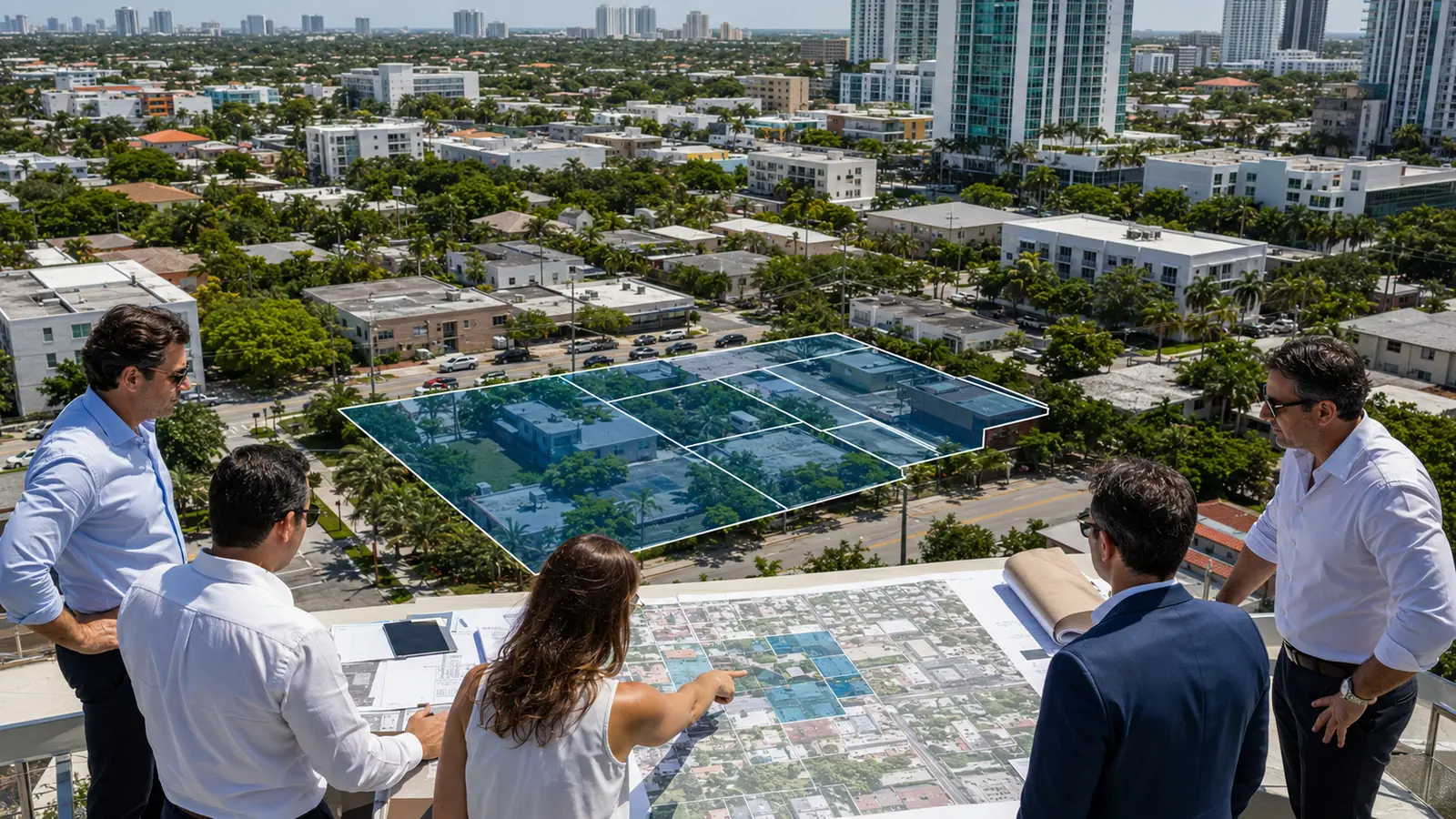
South Florida development land is usually valued on allowable and achievable buildable area, not simply acreage. A small parcel with favorable zoning, frontage and assemblage potential may command more per acre than a larger constrained site. The decisive metric is often land cost per buildable square foot or per approved unit after entitlement risk is considered.
Land scarcity, fragmented ownership, flood and infrastructure constraints and changing density rules make Miami assemblage economics highly site-specific. Public records and zoning must be reconciled with a feasible concept before a headline per-acre price is meaningful. For the broader market framework, read our construction loans florida.
Key Takeaways
- Zoning density and height
- Assemblage control
- Whether to buy outright or option the land
- How to value holdout parcels
Why Land Trades on Buildable Feet, Not Acres
Why Land Trades on Buildable Feet, Not Acres is where the market narrative becomes an underwriting question. The analysis below connects the visible headline to the cash flow, documentation and timing that determine the actual result.
Another critical variable is zoning density and height. The headline treatment often understates how this factor interacts with leverage, liquidity and timing. In practice, a favorable answer can expand options, while an unresolved answer can narrow the lender pool or reduce a buyer’s willingness to proceed. The correct approach is to quantify the effect, assign an owner to the unresolved item and establish the date by which it must be resolved. That turns a vague market risk into a decision that can be monitored.
That issue connects directly with our analysis of Miami’s Development Pipeline: The Projects That Will Define 2027.
Assemblage control deserves a separate sensitivity test. The base case should use current evidence, but the underwriting case should also model a less favorable result. For south florida land prices, the important question is not whether the optimistic outcome is possible; it is whether the capital structure and operating plan can survive a reasonable setback. This is where stronger equity, additional reserves, flexible timing or a lower purchase basis can create more value than a marginally lower quoted rate.
Corridor Table: Land values by submarket and zoning envelope
This section separates structural forces from temporary conditions. The distinction matters because a short-term adjustment may change pricing, while a structural change can alter eligibility, value and the long-run buyer or lender pool.
| Land metric | Use | Caution |
|---|---|---|
| Price per acre | Broad comparison of similar sites | Misleading when zoning differs |
| Price per buildable square foot | High-rise and mixed-use analysis | Requires realistic entitlement and efficiency |
| Price per unit | Multifamily or condo comparison | Unit size and affordability rules matter |
| Residual land value | Project-specific feasibility | Highly sensitive to rent, cost and cap rate |
The table is a framework for comparison, not a substitute for property-specific evidence. The most useful application is to identify which input can change the decision and to update that input as new information arrives. As of July 16, 2026, the market remains selective enough that small differences in leverage, documentation, building condition or timing can produce materially different outcomes.
The next decision point is examined in The Live Local Act: How Florida’s Housing Law Is Reshaping Development Deals.
The Assemblage Game
The useful framework is evidence first, scenario second and decision third. Current data establishes the base case; a downside scenario tests resilience; the resulting threshold guides action.
Condo terminations as land plays, ties C1
The market signal embedded in parking and access is easy to miss. It can reveal whether pricing is being supported by durable income and demand or by temporary financing conditions. Miami Finance Review treats the signal as part of a system rather than an isolated statistic: direction, dispersion by submarket and the financing response all matter. When those three elements move together, the signal is more useful for decisions than a single citywide average.
For adjacent context, see Milestone Inspections and SIRS: Florida’s Condo Safety Rules and Their Market Impact.
Holdout math
From an execution standpoint, flood elevation and infrastructure should be documented before the transaction reaches its final deadline. Late discovery usually has a nonlinear cost because it can force a new appraisal, revised structure, additional equity or contract extension. Teams that assemble the evidence early can compare alternatives while they still have negotiating leverage. Teams that wait often confuse urgency with certainty and accept a solution that is more expensive or less flexible.
Financing Land: Why It Is the Hardest Money to Borrow
For South Florida readers, the answer often varies by building, submarket and capital source. The regional trend provides context, but the property-level facts control the transaction.
The risk around affordable-housing incentives is best managed through explicit thresholds. A buyer, developer or lender can define the maximum acceptable exposure, the evidence required to proceed and the condition that triggers a pause. This approach is particularly useful in South Florida, where insurance, condominium governance, international capital and construction timing can produce property-level outcomes that diverge sharply from regional headlines. Clear thresholds preserve discipline when the market narrative becomes emotional.
Readers evaluating the same risk should also review Fix and Flip Financing in South Florida: Bridge, Hard Money and the Exit Math.
Consider demolition and relocation cost as part of the exit, not only the entry. A structure that closes efficiently today may reduce refinance proceeds, sale flexibility or future buyer eligibility. The analysis should therefore compare the initial benefit with the cost under at least two exit dates and one adverse market case. For professional readers, this forward view is often the difference between a transaction that merely closes and an investment that remains financeable.
What This Means For Developers and Land Owners
The implications differ by role because each participant controls a different part of the outcome. The following framework converts the market analysis into practical priorities.
Developers
Control the site long enough to complete zoning, title, environmental and utility diligence.
Landowners
Understand how density, frontage and assemblage position affect value before accepting a simple acre comparison.
Capital providers
Underwrite the entitled case and the fallback use separately.
A Practical Decision Framework
The most effective way to use this analysis is to convert it into a sequence. First, define the objective and the nonnegotiable constraint. Second, gather the primary evidence and date every material input. Third, run a base case and a downside case. Fourth, compare at least two structures or strategies. Finally, document the trigger that would change the decision. This process reduces the risk of allowing a headline, a rate quote or a single comparable sale to dominate a complex transaction.
Whether to buy outright or option the land
Consider whether to buy outright or option the land as part of the exit, not only the entry. A structure that closes efficiently today may reduce refinance proceeds, sale flexibility or future buyer eligibility. The analysis should therefore compare the initial benefit with the cost under at least two exit dates and one adverse market case. For professional readers, this forward view is often the difference between a transaction that merely closes and an investment that remains financeable.
The capital-markets consequence is developed further in development financing checklist.
How to value holdout parcels
Reliable decisions require a common definition of how to value holdout parcels. Borrowers, brokers, associations, appraisers and investors may use the same phrase to describe different calculations or documents. The article uses the term only after identifying the measurement period, source and as-of date. That precision supports better comparisons, reduces avoidable disputes and makes future updates possible when the data changes.
Whether a condo termination is feasible
The first analytical issue is whether a condo termination is feasible. In the context of Land Prices and Assemblage Economics in South Florida, this is not a secondary checklist item. It changes the amount of risk that can be transferred, financed or priced. Market participants should identify the responsible party, the evidence available as of the review date and the downside case if the assumption fails. A disciplined file separates what is documented from what is projected, then asks whether the transaction still works when the projection is delayed or reduced.
Whether density incentives are financeable
Another critical variable is whether density incentives are financeable. The headline treatment often understates how this factor interacts with leverage, liquidity and timing. In practice, a favorable answer can expand options, while an unresolved answer can narrow the lender pool or reduce a buyer’s willingness to proceed. The correct approach is to quantify the effect, assign an owner to the unresolved item and establish the date by which it must be resolved. That turns a vague market risk into a decision that can be monitored.
Risks and Signals to Watch
No static article can remove market risk. The objective is to identify the variables that should be refreshed and the events that require a new decision. Readers should update the analysis when financing terms, insurance, legal requirements, project status, rent, vacancy, appraisal evidence or material property documents change.
- Zoning assumptions that do not survive review
- Holdout escalation
- Environmental or title issues
- Unfunded infrastructure
- Land basis that leaves no construction contingency
The market signal embedded in zoning assumptions that do not survive review is easy to miss. It can reveal whether pricing is being supported by durable income and demand or by temporary financing conditions. Miami Finance Review treats the signal as part of a system rather than an isolated statistic: direction, dispersion by submarket and the financing response all matter. When those three elements move together, the signal is more useful for decisions than a single citywide average.
From an execution standpoint, holdout escalation should be documented before the transaction reaches its final deadline. Late discovery usually has a nonlinear cost because it can force a new appraisal, revised structure, additional equity or contract extension. Teams that assemble the evidence early can compare alternatives while they still have negotiating leverage. Teams that wait often confuse urgency with certainty and accept a solution that is more expensive or less flexible.
The risk around environmental or title issues is best managed through explicit thresholds. A buyer, developer or lender can define the maximum acceptable exposure, the evidence required to proceed and the condition that triggers a pause. This approach is particularly useful in South Florida, where insurance, condominium governance, international capital and construction timing can produce property-level outcomes that diverge sharply from regional headlines. Clear thresholds preserve discipline when the market narrative becomes emotional.
Methodology and Editorial Standard
This analysis was prepared for Miami Finance Review in Brickell, Miami, and updated July 16, 2026. It relies on primary or first-party material including Miami-Dade County Property Appraiser; Miami-Dade County Open Data Hub; Florida Legislature, Fla. Stat. §420.50872, Live Local Program. Figures are treated as dated observations rather than permanent market truths. Where a table is illustrative, it is labeled accordingly and is intended to explain a decision framework, not to quote a loan, predict a guaranteed outcome or replace legal, tax, engineering or investment advice.
Frequently Asked Questions
Why is price per acre not enough in Miami?
Two sites of the same size can support very different density, height, parking and infrastructure obligations.
What is a land assemblage?
It is the combination of adjacent parcels to create a larger development site or improve access and zoning efficiency.
Why are holdouts expensive?
The final parcel can unlock the entire project, giving its owner disproportionate negotiating leverage.
Can land be financed?
Yes, but land loans usually require substantial equity, strong guarantors and a credible entitlement or construction path.
Primary Sources
Market intelligence. Capital insight. Delivered daily.
Miami Finance Review produces independent editorial analysis. Figures are attributed to their sources and independently cross-checked where possible. This content is informational and is not investment, legal, tax or lending advice.