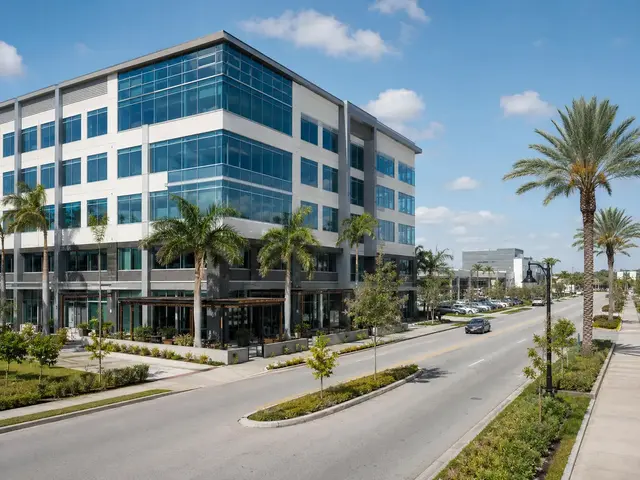
Companies moving to Miami in 2026 include Palantir Technologies, Trinity Investments and GFL Environmental, while D-Wave is preparing a headquarters and research move to Boca Raton. These relocations strengthen South Florida’s corporate profile, but the office-market effect requires more than counting announcements. A headquarters can represent a large operating center, a focused executive office or simply a new principal address.
The Q2 2026 data supports a measured conclusion. CBRE reported 344,000 square feet of positive net absorption, 14.9% vacancy and an average asking rent of $68.60 per square foot in Miami. Cushman & Wakefield reported that second-quarter leasing improved 44.4% from the first quarter, even though year-to-date volume remained 28.5% below the prior year. Miami is attracting corporate decision-makers and premium tenants, but demand is still selective rather than universal.
Key Takeaways
- Four significant South Florida headquarters moves or commitments were publicly confirmed during 2026 as of July 19.
- Palantir, Trinity Investments and GFL established principal or executive headquarters in Miami-Dade County.
- D-Wave plans to move its headquarters and a key U.S. research facility from Palo Alto to Boca Raton before the end of 2026.
- Miami office net absorption reached 344,000 square feet in Q2, while vacancy measured 14.9%.
- Average asking rent reached $68.60 per square foot, but year-to-date leasing activity remained below 2025.
- A headquarters announcement should not be treated as office demand until lease size, staffing and occupancy are documented.
Companies Moving to Miami in 2026: Confirmed Headquarters Relocations
The South Florida corporate relocation story spans technology, investment management, environmental services and quantum computing. The table separates moves already reflected in corporate addresses from a relocation scheduled for later in the year.
| Company | Destination | 2026 status | What the company disclosed | Office-demand implication |
|---|---|---|---|---|
| Palantir Technologies | Aventura, Miami-Dade | Principal executive address changed | Palantir listed an Aventura address as its principal executive office in February. | No local headcount or dedicated lease size was disclosed in the address notice. |
| Trinity Investments | Miami | Headquarters established | The Miami office became the firm’s primary executive headquarters and a base for investment strategy, capital markets and global partnerships. | Clear executive and investment-function presence, but the announcement did not quantify square footage. |
| GFL Environmental | Miami Beach | Executive headquarters relocated | GFL moved its executive headquarters from Vaughan, Ontario, while retaining its Canadian incorporation and shared-service hubs. | Strategic executive relocation, not a transfer of the company’s entire operating workforce. |
| D-Wave Quantum | Boca Raton | Planned before year-end | D-Wave selected Boca Raton Innovation Campus for its headquarters and a key U.S. research and development facility. | Potentially more operationally intensive because research, testing and support functions are planned at the site. |
Sources: Palantir investor notice, Trinity Investments, GFL Environmental and D-Wave Quantum.
What the Q2 2026 Miami Office Data Shows
The market data is constructive, but mixed. Positive absorption and higher rents indicate that occupied space grew and premium buildings retained pricing power. At the same time, lower year-to-date leasing volume shows that the market has not entered a broad-based expansion.
| Metric | Latest reading | Comparison | Interpretation |
|---|---|---|---|
| Net absorption | 344,000 sf | 264,000 sf above Q1 | Occupied space increased during the quarter. |
| Vacancy | 14.9% | Lower than the prior period | Improvement, but enough vacancy remains to make building quality important. |
| Average asking rent | $68.60 per sf | Up 6.5% year over year | Premium space and new top-tier inventory lifted the market average. |
| Space under construction | 1.3 million sf | 94,000 sf delivered in Q2 | New supply can support relocations while increasing competition among landlords. |
| Year-to-date leasing | 830,500 sf | Down 28.5% year over year | Annual demand remained below the prior year’s pace. |
| Q2 leasing activity | 490,600 sf | Up 44.4% from Q1 | Sequential activity improved after a slower first quarter. |
Sources: CBRE Miami Office Figures, Q2 2026 and Cushman & Wakefield Miami Office MarketBeat, Q2 2026. Research firms may use different building sets and calculation methods, so their metrics should be read as complementary rather than combined into one time series.
CBRE also reported 1.3 million square feet under construction. New premium inventory can accommodate companies that want modern space, amenities and resilient infrastructure. It can also widen the gap between top-tier buildings and older assets that need capital improvements. Our analysis of Miami office repositioning strategies explains how landlords can respond to that flight to quality.
Why Companies Are Moving to Miami and South Florida
Executive and capital networks
Headquarters decisions often follow the location of senior leadership, investors and clients. Miami’s finance, real estate, hospitality and technology networks have become denser, making the region more useful as a place to make decisions rather than only maintain a satellite office. Trinity’s announcement specifically identified global capital, institutional partners and hospitality markets as reasons for establishing its executive base in Miami.
Personal tax policy and relocation incentives
The Florida Department of Revenue confirms that the state does not impose a personal income tax. That can matter to executives and highly compensated employees. It does not mean a company operates tax-free: federal taxes, Florida corporate taxes, property taxes, sales taxes and local costs still apply. Miami-Dade also offers targeted relocation and expansion incentives in qualifying economic-development areas, but eligibility is project-specific.
Global connectivity
Miami International Airport handled 55.3 million passengers in 2025, including 24.8 million international travelers, according to Miami-Dade Aviation Department data. That connectivity supports companies with operations, investors or customers across Latin America, the Caribbean and Europe. For headquarters teams, direct access can reduce the friction of managing a cross-border platform. It also connects executive functions with South Florida’s broader industrial and logistics market.
Sector clusters and institutional support
The region is not relying on a single industry. The 2026 relocation list includes data analytics, hospitality investment, environmental services and quantum computing. In a 2025 partnership announcement, the Miami-Dade Beacon Council said 45 companies had expanded or relocated headquarters to Greater Miami during the preceding year, with commitments tied to more than 10,000 jobs and $800 million of capital investment. Those were projected commitments, not completed 2026 results, but they show the depth of the relocation pipeline.
Why the Corporate Relocation Headlines Need Context
Corporate relocation stories can overstate near-term office demand if every announcement is treated as a large lease. The details matter:
- Headquarters status: A legal or principal address may involve a compact executive team rather than a large workforce.
- Lease structure: Coworking, sublease and direct-lease occupancy have different implications for landlords and market absorption.
- Timing: An announced relocation may not affect occupancy until construction, permitting and hiring are complete.
- Retained locations: Companies often keep teams and shared services in their previous markets.
- Geography: Miami, Aventura, Miami Beach and Boca Raton are part of one regional business story, but they are separate office submarkets.
D-Wave illustrates the difference. Its Boca Raton move is scheduled before the end of 2026 and includes research, testing and support functions, giving it a clearer operating component than a simple address change. GFL, by contrast, disclosed that it would maintain shared-service hubs in Canada and North Carolina after moving its executive headquarters to Miami Beach.
What the Relocation Wave Means for Market Participants
For office landlords
Prioritize reliable building systems, flexible layouts, amenities, security and move-in certainty. Corporate tenants may pay for quality, but they will compare total occupancy cost and delivery risk across multiple submarkets.
For investors
Do not capitalize relocation headlines without tenant-level evidence. Review signed leases, concessions, tenant-improvement obligations, rollover exposure and the durability of rent after free periods expire.
For lenders
Separate market momentum from property cash flow. Underwrite lease commencement, expense stops, capital requirements, sponsor liquidity and refinance assumptions under both base and slower-leasing cases.
The broader capital implications are examined in our South Florida financing outlook, Miami commercial real estate outlook and analysis of Miami cap rates in 2026.
Where Office Demand Could Concentrate
The relocation pattern is regional rather than confined to one central business district. Brickell and Downtown Miami offer proximity to finance, legal services and transit. Miami Beach and Aventura can appeal to executive teams seeking proximity to residential concentrations and flexible office options. Boca Raton and Palm Beach County offer a technology, finance and research corridor with access to universities and established corporate campuses.
This distribution creates opportunity and risk. A tenant choosing South Florida does not guarantee demand for every Miami office building. Owners still compete on location, parking, resilience, operating expenses, floor-plate efficiency and the cost of delivering space. The best-performing assets should be those that match a specific tenant’s labor, client and executive geography.
Five Signals to Watch Through the End of 2026
- Disclosed local hiring: Employee commitments provide better evidence of economic impact than a headquarters label alone.
- Signed lease size: Square footage and commencement dates translate announcements into measurable demand.
- Net absorption and sublease availability: These show whether occupied space is growing after move-outs and givebacks.
- Top-tier versus commodity rents: A widening spread would confirm that relocation demand is concentrating in better buildings.
- Preleasing in new construction: Commitments made before delivery indicate whether the 1.3-million-square-foot pipeline is meeting real tenant demand.
Methodology and Limitations
This analysis uses company disclosures, official investor notices and Q2 2026 office-market reports available by July 19, 2026. The relocation scorecard is selective rather than exhaustive. It includes publicly confirmed headquarters moves with direct relevance to Miami-Dade, Broward or Palm Beach counties.
CBRE and Cushman & Wakefield may define market inventory, building classes, transactions and absorption differently. Their statistics are attributed separately and should not be blended without access to the underlying datasets. Corporate announcements may omit local staffing, lease size, incentives and phased occupancy, so this article does not estimate undisclosed economic impact.
The Bottom Line
Companies are moving headquarters to Miami and South Florida in 2026, and the pattern now spans several high-value industries. The office-market data adds support: absorption was positive, vacancy improved and asking rents increased. Yet year-to-date leasing remained below the prior year, which argues against treating every relocation announcement as evidence of a broad office boom.
The strongest conclusion is narrower and more useful. South Florida is gaining corporate decision-makers and selected operating functions. That should support premium office assets and the region’s business ecosystem, but building performance will still depend on actual leases, staffing, capital requirements and location-specific demand.
Frequently Asked Questions
What companies are moving to Miami in 2026?
Palantir Technologies changed its principal executive address to Aventura, Trinity Investments established its primary executive headquarters in Miami and GFL Environmental relocated its executive headquarters to Miami Beach. D-Wave plans to move its headquarters and a key research facility to Boca Raton before the end of 2026.
Why are companies moving their headquarters to Miami?
Common factors include executive and investor networks, access to Latin America and global markets, Florida’s lack of a personal income tax, airport connectivity, lifestyle considerations and the availability of premium office space. The weight of each factor varies by company.
Did Palantir move its headquarters to Miami?
Yes. Palantir listed 19505 Biscayne Boulevard in Aventura as its principal executive office in February 2026. Its public address notice did not disclose Miami headcount or dedicated office square footage.
Is D-Wave moving its headquarters to South Florida?
Yes. D-Wave announced that it plans to transition its headquarters from Palo Alto to Boca Raton before the end of 2026 and establish a key U.S. research and development facility at Boca Raton Innovation Campus.
How are corporate relocations affecting the Miami office market?
Relocations support demand for executive, premium and specialized space, but their total impact depends on lease size and staffing. Q2 2026 produced 344,000 square feet of positive net absorption, while year-to-date leasing volume remained below 2025.
Is the Miami office market strong in 2026?
The market is improving but selective. Q2 vacancy measured 14.9%, net absorption was positive and average asking rent reached $68.60 per square foot. However, year-to-date leasing activity was down 28.5% from the prior year.
Does Florida have a personal income tax?
No. The Florida Department of Revenue states that Florida does not impose a personal income tax. Companies and residents may still owe federal, corporate, property, sales and other applicable taxes.
What should landlords verify before counting a headquarters move as office demand?
Landlords should verify signed lease size, commencement date, local staffing, direct versus flexible-space occupancy, tenant-improvement obligations and whether the company is consolidating or retaining other locations.
Primary Sources
- CBRE: Miami Office Figures Report, Q2 2026
- Cushman & Wakefield: Miami Office MarketBeat, Q2 2026
- Palantir Technologies: Principal Executive Office Address Change
- Trinity Investments: New Headquarters in Miami
- GFL Environmental: Executive Headquarters Relocation
- D-Wave Quantum: Boca Raton Headquarters and R&D Facility
- Miami-Dade Aviation Department: 2025 Passenger and Cargo Data
- Florida Department of Revenue: Personal Income Tax Statement
- Miami-Dade Beacon Council: Headquarters Expansion and Relocation Context
Featured photo by Sergio Arteaga via Unsplash.
Market intelligence. Capital insight. Delivered daily.
Miami Finance Review produces independent editorial analysis. Figures are attributed to their sources and independently cross-checked where possible. This content is informational and is not investment, legal, tax or lending advice.