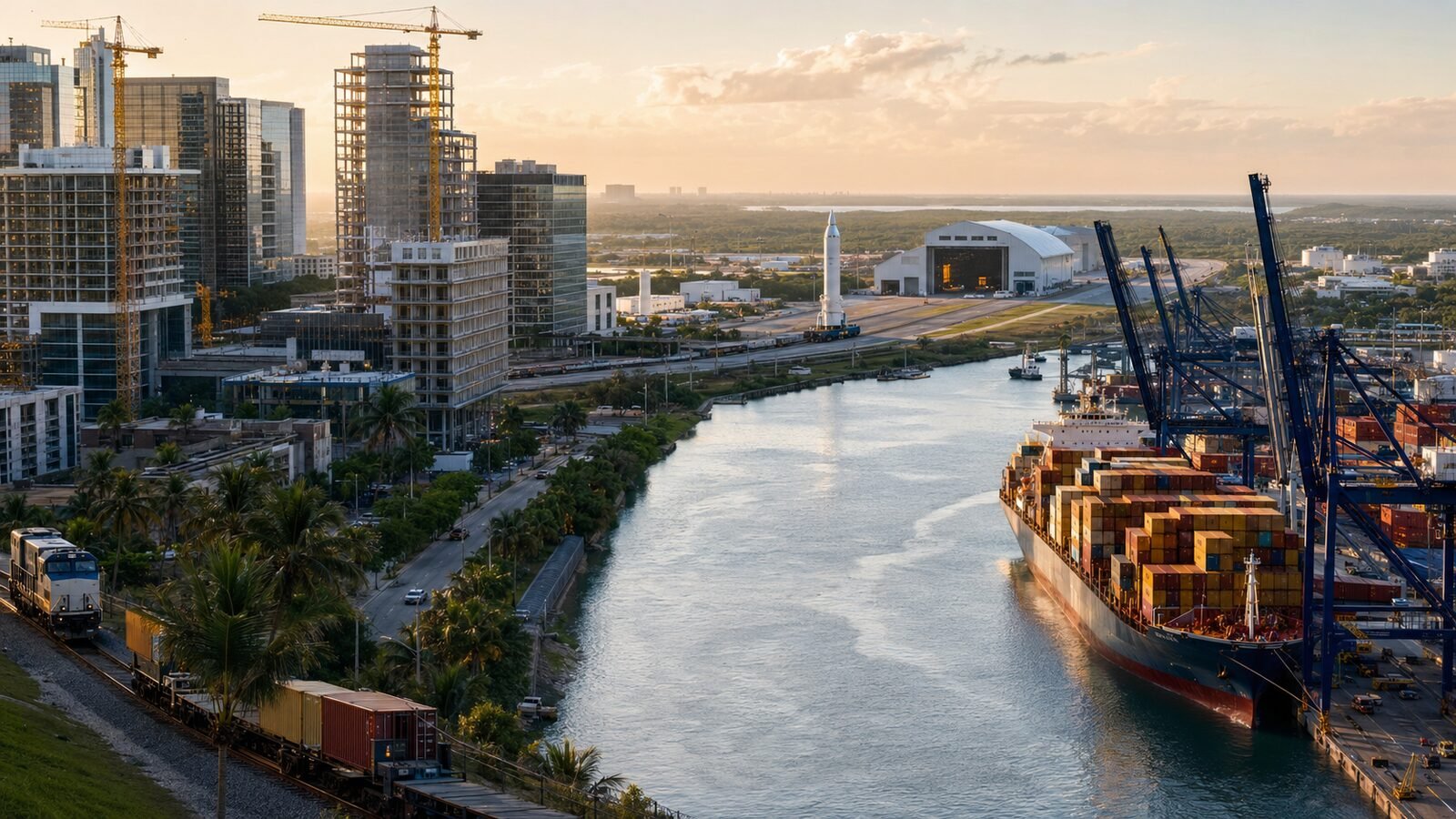
Florida’s economy has entered a new weight class. The state produced roughly $1.83 trillion in current-dollar output in 2025, equal to about 6 percent of the United States economy, while inflation-adjusted growth reached 3.1 percent. That tied Florida for the fastest growth among the states and placed its economic scale in the range of the world’s 15 largest national economies. The deeper story is not a single boom in population or property values. Florida is converting household migration, private wealth, financial-sector expansion, tourism, logistics and advanced industry into a larger, more durable capital ecosystem.
Key takeaways
- Florida’s current-dollar economy reached approximately $1.83 trillion in 2025, making it the fourth-largest state economy and representing about 6 percent of total US output.
- Real gross domestic product grew 3.1 percent in 2025, tying South Carolina for the fastest growth among the states and exceeding the 2.1 percent national rate.
- Florida added 196,680 residents between July 2024 and July 2025, the second-largest numeric gain in the country, bringing the population to 23.46 million.
- Income migration remains a major advantage. The latest IRS county-to-county data show that Florida gained a net $20.65 billion in adjusted gross income from domestic migration during the 2022 to 2023 filing-year comparison.
- South Florida is becoming an operating center for finance, not merely a residential destination for wealthy households. Citadel, KKR and Wells Fargo are among the institutions expanding their permanent presence.
- The next phase will be more demanding. Florida’s June 2026 unemployment rate was 4.7 percent, above the 4.2 percent national rate, while housing costs, insurance and infrastructure remain important constraints.
Data note: This analysis uses the latest complete annual state GDP figures available as of July 29, 2026, along with June 2026 labor data, July 2025 population estimates and the latest IRS migration statistics. Current-dollar GDP measures the size of the economy at prevailing prices. Real GDP adjusts for inflation and is the better measure of underlying growth.
Florida economy at a glance
| Indicator | Latest figure | What it shows |
|---|---|---|
| Current-dollar GDP | Approximately $1.83 trillion in 2025 | Florida is the fourth-largest state economy and produces about 6 percent of US output |
| Real GDP | Approximately $1.39 trillion in 2025 | Inflation-adjusted output reached a record level |
| Real GDP growth | 3.1 percent in 2025 | Tied for fastest among the states and exceeded the 2.1 percent US rate |
| Population | 23,462,518 on July 1, 2025 | Florida remains the third-most-populous state |
| Annual population gain | 196,680 residents | Second-largest numeric increase among the states from 2024 to 2025 |
| Net domestic income inflow | $20.65 billion | Largest state gain in adjusted gross income in the latest IRS migration data |
| Labor force | 11.14 million in June 2026 | A large employment base that supports continued business expansion |
| Unemployment rate | 4.7 percent in June 2026 | Shows a cooler labor market and a need for more selective growth |
| Visitors | 143.3 million in 2025 | A preliminary annual record and evidence of continued tourism scale |
Sources: US Bureau of Economic Analysis, US Census Bureau, Internal Revenue Service, US Bureau of Labor Statistics and VISIT FLORIDA.
How large is Florida’s economy in 2026?
Florida is now the fourth-largest state economy in the United States, behind California, Texas and New York. The Bureau of Economic Analysis estimates that current-dollar output reached approximately $1.83 trillion in 2025. That is the broadest measure of the value generated by businesses, governments and households across the state.
Scale alone does not prove that an economy is healthy. A state can appear larger because prices are rising or because it has added residents without improving productivity. Florida’s inflation-adjusted performance is therefore the more important signal. Real GDP increased 3.1 percent in 2025, tying South Carolina for the fastest state growth and comfortably exceeding the 2.1 percent national pace.
The result shows that Florida was not simply inflating into a larger number. Its underlying production expanded faster than the country as a whole.
The comparison is even more striking over a longer horizon. Florida has moved from a tourism, retirement and construction narrative toward a diversified platform that now includes financial services, aerospace, health care, logistics, technology, professional services and a growing base of private investment. Real estate remains central, but it increasingly functions as the physical infrastructure for a broader economy rather than as a self-contained cycle.
If Florida were a country, where would it rank?
Comparing Florida’s 2025 current-dollar output with the International Monetary Fund’s 2025 nominal GDP estimates would place the state at approximately 15th in the world. At roughly $1.83 trillion, Florida would be in the same economic tier as Australia, Mexico, South Korea and Spain.
This is a scale comparison, not an official national ranking. Florida is part of the United States, does not maintain an independent currency and benefits from federal fiscal, legal and financial systems. Country rankings can also shift with exchange rates and subsequent data revisions. Even with those limitations, the comparison provides useful perspective: one state now generates output comparable with that of a major national economy.
For investors and companies, scale creates practical advantages. It supports a large consumer market, a deep labor pool, multiple metropolitan centers and enough transaction volume to sustain specialized legal, financial, construction and advisory services. It also gives companies more reasons to establish permanent operations instead of treating Florida as a satellite market.
The six engines reshaping Florida’s economy
1. Population growth keeps expanding the economic base
Florida’s population reached 23.46 million on July 1, 2025, according to the Census Bureau. The state added 196,680 residents over the preceding year, the second-largest numeric gain in the country after Texas.
The pace of domestic migration has cooled from its pandemic-era peak, and that normalization matters. Florida cannot assume that unusually large annual inflows will continue indefinitely. Yet the economic base created by years of migration does not disappear when the pace slows. New residents need housing, medical care, schools, financial services, restaurants, transportation and local professional services. Many also arrive with businesses, investment capital or remote income.
The better way to understand the migration story is cumulative. Florida has added millions of residents over the past decade, deepening demand across several metropolitan areas at once. Miami and Fort Lauderdale attract international capital and financial firms. West Palm Beach has become a wealth-management center. Orlando combines tourism with simulation, defense and technology. Tampa Bay has developed a larger professional-services and health care base. Jacksonville adds logistics, finance and manufacturing capacity.
This broader geography makes the state less dependent on a single urban market. Our analysis of Florida migration and housing demand explains how population flows affect different housing markets unevenly.
2. Income migration is more important than the resident count
Population headlines measure people. Tax-return migration data measure economic capacity.
The latest IRS data, covering address changes between the 2022 and 2023 filing years, show that Florida gained a net $20.65 billion in adjusted gross income from domestic migration. That was the largest net income gain among the states. Florida has accumulated approximately $137 billion in net adjusted gross income through domestic migration from 2019 through 2023, according to an analysis of IRS data by Miami Realtors.
This distinction is central to Florida’s finance story. A high-income household can have an economic impact far beyond one additional resident. It may purchase property, establish a family office, move a company, hire professional advisers, invest in local businesses and direct philanthropic capital. Even when population growth moderates, an inflow of income and assets can continue to strengthen bank deposits, investment activity, luxury demand and business formation.
Palm Beach County illustrates the pattern. It ranked first nationally for net inflow of adjusted gross income in the latest IRS county analysis. That helps explain why West Palm Beach has attracted wealth managers and financial institutions at a pace that would have appeared improbable a decade ago.
3. Real estate is becoming economic infrastructure
Florida real estate is often discussed as the output of growth. Increasingly, it is also an input.
New offices give relocating companies somewhere to operate. Apartments and condominiums house the employees and executives those firms recruit. Hotels, retail districts and mixed-use projects support tourism and business travel. Industrial properties serve ports, airports and distribution networks. Data centers, health care facilities and advanced-manufacturing buildings support the next generation of economic activity.
South Florida provides the clearest examples. Miami’s office market has absorbed a wave of financial and professional-services tenants. West Palm Beach is developing an institutional office cluster around firms that serve private wealth. Fort Lauderdale is adding mixed-use districts that connect housing, transit and employment, including the FAT Village redevelopment.
The housing market is also more segmented than the national conversation suggests. Miami-Dade recorded 24 residential sales above $30 million during the first half of 2026, surpassing both New York City and the Bay Area in that ultra-luxury segment. Miami Finance Review’s report on the Miami ultra-luxury real estate market shows how global wealth is reshaping the top of the market.
At the same time, much of Florida faces affordability pressure, higher ownership costs and pockets of growing inventory. Those conditions do not invalidate the long-term thesis. They make asset selection, location and basis more important. A broad state economy can support attractive real estate outcomes without lifting every property type or neighborhood equally.
4. Finance is becoming a permanent South Florida industry
The early Florida relocation story focused on where executives lived. The current phase is about where firms build operating capacity.
Citadel identifies Miami as its global headquarters and is planning a major headquarters complex. KKR opened a permanent Brickell office in 2026 to serve institutional investors, family capital, private wealth and Latin American relationships. Wells Fargo announced plans to move the headquarters of its Wealth and Investment Management division to West Palm Beach, with an expected move in August 2026.
Each institution has a different strategy, but together they point to a structural change. South Florida now offers a dense client base, international connectivity, a growing professional workforce and an expanding network of law firms, accounting firms, recruiters, developers and capital providers. That network effect is difficult to measure in a single GDP release, but it is one of the most valuable consequences of the migration cycle.
The region is also gaining depth in private credit. Banks remain essential, yet alternative lenders are financing bridge loans, construction projects, transitional commercial properties and complex acquisitions that do not fit conventional credit boxes. Our analysis of private credit in Florida real estate examines how this market is changing deal execution.
Capital availability has improved from the most restrictive point of the recent cycle. Commercial real estate lending increased sharply in early 2026 as competition among lenders returned, although underwriting remains disciplined. That recovery, analyzed in Miami Finance Review’s capital-markets report, gives well-positioned Florida projects more financing options.
5. Tourism, trade and transportation remain enormous advantages
Diversification does not mean Florida has outgrown tourism. It means the state can use its visitor economy as one powerful engine among several.
Florida welcomed a preliminary record 143.3 million visitors in 2025. Domestic travelers accounted for 131.1 million, overseas visitors for 9.3 million and Canadian visitors for 2.9 million. A separate state economic-impact study estimated that tourism generated $133.6 billion of economic activity in 2024 and supported 1.8 million jobs.
The scale supports hotels, restaurants and attractions, but its influence extends further. High passenger volumes justify more air service. International routes make Florida more useful to companies managing Latin American and Caribbean business. Tourism also introduces potential residents, investors and business owners to the state.
Miami International Airport is a particularly valuable connector. Its passenger, cargo and trade functions link South Florida with global markets and reinforce the region’s role as a headquarters location. Miami Finance Review’s review of Miami International Airport’s economic impact explains how aviation capacity feeds real estate and business demand.
6. Aerospace and advanced industry widen the growth story
Florida’s next chapter is not limited to services. The aerospace sector is expanding around the Space Coast, supported by launch activity, manufacturing and public infrastructure.
Space Florida reported 109 launches in 2025 and a pipeline of 220 projects valued at approximately $6 billion. Blue Origin separately announced a $600 million manufacturing expansion expected to create 500 high-wage aerospace jobs and add an 830,000-square-foot facility.
These investments matter because they add technical employment, supplier demand and export-oriented activity. They also demonstrate that Florida can compete for complex, capital-intensive operations. The same principle applies to life sciences, defense, aviation maintenance and logistics projects elsewhere in the state.
Why Florida’s tax structure matters, and what it does not explain
Florida does not impose an individual state income tax, including a separate individual capital-gains tax. That is a meaningful advantage for high earners, entrepreneurs and investors comparing locations.
Tax policy is not a complete economic strategy, however. People and companies also evaluate airports, schools, housing, safety, infrastructure, workforce depth, cultural amenities and access to customers. Florida’s strongest markets are succeeding because the tax advantage is paired with a broader platform.
The no-income-tax structure also creates tradeoffs. State and local governments rely more heavily on sales taxes, property taxes, tourism-related revenue and other sources. Rapid growth increases the need for transportation, water, schools and resilient infrastructure. Preserving Florida’s economic advantage therefore requires disciplined public investment, not merely a favorable tax headline.
What the 2026 labor market says about the expansion
Florida’s current growth cycle is strong, but it is not frictionless. The state’s unemployment rate reached 4.7 percent in June 2026, compared with 4.2 percent nationally. Nonfarm payroll employment was approximately 10.03 million, only 0.3 percent above a year earlier. Construction employment was down 0.5 percent over the same period.
These figures are evidence of a cooler labor market after years of unusually rapid expansion. They should not be minimized. Slower job creation can affect household formation, apartment absorption, retail spending and demand for entry-level housing.
They also need context. Florida still has an 11.14 million-person labor force, a large and diverse economic base, and 2025 real growth that led the country. The central question is whether the state can move from migration-driven expansion to productivity-driven growth. That requires companies that create high-value jobs, infrastructure that reduces congestion and housing that allows workers to live within practical reach of employment centers.
The four constraints that will decide Florida’s next phase
Housing affordability
Florida’s success has increased the cost of access to its strongest markets. Elevated prices and borrowing costs make homeownership difficult for many local households. Rents have stabilized or declined in some supply-heavy areas, but the statewide affordability problem remains significant.
The solution is not uniform construction everywhere. Florida needs housing in locations connected to employment, transportation and services, with a range of price points and unit types. Local permitting speed, impact fees, insurance requirements and infrastructure capacity will influence what can be built economically.
Property insurance and climate exposure
Insurance costs affect homeowners, condominium associations, landlords, developers and lenders. Premiums can change whether a transaction qualifies, whether a project produces an acceptable return and whether an existing owner can afford to remain in place.
Florida has taken steps to stabilize the market, but investors should continue to underwrite premiums, deductibles, reserves, flood exposure and building condition at the asset level. A strong state economy does not eliminate physical risk. It increases the importance of resilience because more capital and property value are exposed.
Infrastructure
Population and business growth place pressure on airports, roads, transit, water systems, schools and power infrastructure. Capacity investments can unlock development and improve productivity. Delays can turn growth into congestion and raise the cost of operating.
South Florida’s expansion of rail, airport and port infrastructure is strategically important, but the state will need continued investment across all major metros. The return is economic as well as civic: reliable infrastructure makes Florida more competitive for corporate operations and advanced industry.
Talent development
Relocated executives can accelerate a market, but durable clusters require local talent. Universities, vocational programs and employers need to expand pathways into finance, aerospace, construction management, health care, engineering and technology.
The long-term prize is not simply attracting a company headquarters. It is creating a labor market deep enough for that company, its competitors and its suppliers to keep hiring in Florida.
What investors, developers and business leaders should watch next
Six indicators will show whether Florida is converting recent growth into a more durable economy:
- Real GDP relative to the United States. Continued outperformance would confirm that the state is increasing production, not simply prices and population.
- Net adjusted gross income from migration. Income flows reveal whether Florida continues attracting economically significant households even as raw migration slows.
- High-value job creation. Finance, aerospace, technology, health care and professional-services employment will show whether diversification is deepening.
- Office occupancy by operating teams. Permanent employees and decision-makers matter more than mailing addresses or small satellite offices.
- Housing and insurance costs. These expenses will influence workforce retention, consumer spending and project feasibility.
- Capital formation and transaction volume. A sustainable rebound in lending, investment and development activity would demonstrate that Florida’s capital ecosystem is functioning through a higher-rate environment.
Florida’s outlook: scale becomes strategy
Florida’s $1.8 trillion economy is not the product of one market, one migration wave or one property cycle. It reflects a long accumulation of residents, income, companies, infrastructure and private capital.
The positive case for Florida is compelling. The state has a large consumer base, international gateways, no individual state income tax, record tourism, a growing aerospace industry and several metropolitan areas capable of attracting investment. South Florida has evolved into a meaningful financial center, while Central and North Florida add industrial, logistical, defense and technology capacity.
The next phase will be more selective than the last. Slower labor growth, housing costs, insurance and infrastructure will distinguish markets and projects that can compound from those that relied too heavily on easy conditions. That is a healthy transition for a state of Florida’s scale.
The central opportunity is no longer simply to capture migration. It is to turn migration into institutions, talent, productive investment and resilient places. If Florida succeeds, the state will not merely remain one of America’s largest economies. It will become one of its most consequential centers of capital formation.
Frequently asked questions
How large is Florida’s economy in 2026?
The latest complete annual figures show that Florida produced approximately $1.83 trillion in current-dollar GDP in 2025. That makes it the fourth-largest state economy and represents about 6 percent of total US economic output.
How fast is Florida’s economy growing?
Florida’s real GDP grew 3.1 percent in 2025, tying South Carolina for the fastest rate among the states. US real GDP grew 2.1 percent during the same year.
Where would Florida rank if it were a country?
Comparing Florida’s 2025 current-dollar output with IMF country estimates would place it at approximately 15th in the world, near Australia, Mexico, South Korea and Spain. This is an analytical scale comparison, not an official country ranking.
What industries drive Florida’s economy?
Florida’s major economic engines include tourism, real estate, health care, finance, professional services, trade, logistics, aerospace, defense and construction. The state’s recent growth is increasingly distributed across several of these sectors rather than relying on one industry.
How much income is moving to Florida?
The latest IRS migration data show a net inflow of approximately $20.65 billion in adjusted gross income to Florida between the 2022 and 2023 filing years. Florida had the largest net state gain in the country.
Does Florida have a state income tax?
Florida does not impose an individual state income tax. It also does not impose a separate state tax on individual capital gains. Residents may still owe applicable federal taxes and other state or local taxes.
Is Florida’s economy still strong if unemployment is rising?
Florida’s 4.7 percent unemployment rate in June 2026 shows that the labor market has cooled. However, the state also recorded nation-leading real GDP growth in 2025 and maintains an 11.14 million-person labor force. The data point to normalization and a more selective phase of expansion, not a simple reversal of the long-term growth thesis.
Sources and methodology
Miami Finance Review used the latest official data available as of July 29, 2026. State economic output comes from the US Bureau of Economic Analysis. Population estimates come from the US Census Bureau’s Vintage 2025 release. Labor statistics come from the US Bureau of Labor Statistics. Income-migration figures use IRS Statistics of Income migration files and a Miami Realtors analysis of those files. Tourism and aerospace figures come from official Florida releases. Institutional expansion details come from company materials and reporting cited below.
Current-dollar GDP and real GDP answer different questions. Current-dollar GDP describes the economy’s nominal scale. Real GDP removes the effect of price changes and is used here to evaluate growth. The global comparison aligns Florida’s 2025 current-dollar output with 2025 country estimates, but exchange rates and revisions can change the precise rank.
- US Bureau of Economic Analysis: GDP by state
- US Bureau of Economic Analysis: 2025 state GDP and first-quarter 2026 release
- US Census Bureau: Vintage 2025 state population estimates
- Internal Revenue Service: Statistics of Income migration data
- Miami Realtors: Florida and Palm Beach County income migration
- US Bureau of Labor Statistics: Florida economy at a glance
- US Bureau of Labor Statistics: latest state unemployment rates
- VISIT FLORIDA: 2025 visitor estimates
- VISIT FLORIDA: 2024 tourism economic impact
- Space Florida: 2025 launch activity and project pipeline
- Space Florida: Blue Origin manufacturing expansion
- Citadel: Miami headquarters and planned office development
- The Real Deal: KKR permanent Brickell office
- Bloomberg Tax: Wells Fargo wealth headquarters move
- Florida Senate: Constitution of the State of Florida
- Florida Department of Revenue: individual income-tax guidance
Editorial note: Miami Finance Review is an independent publication. This article is for informational purposes and does not constitute investment, legal, tax or financial advice. Economic statistics are subject to revision.
Market intelligence. Capital insight. Delivered daily.
Miami Finance Review produces independent editorial analysis. Figures are attributed to their sources and independently cross-checked where possible. This content is informational and is not investment, legal, tax or lending advice.